
Peace Lily “Domino” and Other Varieties: A Real-World Guide for Buyers and Plant Lovers
If you are searching for Peace Lily “Domino” and other varieties, you are probably trying to answer a practical question. Is Domino worth buying? How is it different from a regular peace lily? Which variety is best for your home? This guide is written for beginners, plant buyers, and indoor plant lovers who want clear answers without fluff.
By the end of this article, you should be able to choose the right peace lily variety for your space, understand whether Domino is the right fit for you, and care for it with confidence.
Quick Summary
| Best for | Indoor plant lovers who want something slightly unique but still beginner-friendly |
|---|---|
| What makes Domino special | Variegated white and green leaves instead of plain green foliage |
| Main difference | Needs brighter indirect light than regular peace lilies |
| Growth | Slower than standard varieties because variegated leaves have less chlorophyll |
| Care difficulty | Easy to moderate, with slightly more attention needed than a basic peace lily |
| Top varieties to compare | Domino, Sensation, and Mauna Loa |
| Biggest mistake | Keeping Domino in low light, which causes it to lose variegation |
What Is Peace Lily “Domino”?
Peace Lily “Domino” is a variegated cultivar of Spathiphyllum, the plant group commonly known as peace lilies. Unlike the standard peace lily, which has solid green leaves, Domino is known for irregular white streaks, splashes, and speckles across deep green foliage.
That variegation is what makes it attractive, but it also changes how the plant behaves. The white parts of the leaf do not contribute much to photosynthesis, so the plant usually grows more slowly and needs more bright, indirect light than a regular peace lily.
In simple terms, Domino is bought for its look, not just for easy greenery. If you want something more decorative than a standard peace lily, it is an excellent option. If you want the easiest possible peace lily, a classic green variety may suit you better.
Domino vs Regular Peace Lily: What Actually Changes?
Many articles say Domino is “similar” to a regular peace lily, which is true, but not helpful enough. Here is what really changes in everyday plant care.
| Feature | Domino | Regular Peace Lily |
|---|---|---|
| Leaf appearance | White and green variegated leaves | Solid green leaves |
| Light needs | Bright indirect light preferred | Tolerates lower light better |
| Growth speed | Usually slower | Usually faster |
| Maintenance | Slightly more attention needed | Very forgiving |
| Best for | Style-conscious plant lovers | Beginners wanting easy care |
The most important point is light. A regular peace lily can survive in lower light, though growth may slow down. Domino can survive there too, but it often loses the white pattern that makes it special. Over time, it may start producing greener leaves. That is one of the most common disappointments people have after buying it.
Popular Peace Lily Varieties You Should Know
1. Domino
Domino is the best-known variegated peace lily. It is usually medium-sized, decorative, and more eye-catching than standard green types. It works best in bright indoor spaces where its leaf pattern can stay crisp and visible.
Best for: People who want a peace lily with stronger visual appeal.
2. Sensation
Sensation is the giant of the peace lily world. It has broad, dramatic leaves and can grow much larger than common varieties. If you want a peace lily that fills a corner or makes a statement in a large room, this is the one many people choose.
Best for: Larger homes, offices, and anyone who wants a bold indoor plant.
3. Mauna Loa
Mauna Loa is one of the classic peace lily varieties. It has traditional green leaves, dependable growth, and the familiar white blooms most people associate with peace lilies. It is also one of the easiest to live with.
Best for: Beginners who want reliable performance with less fuss.
How to Choose the Right Peace Lily Variety
Instead of asking which peace lily is the best overall, ask which one is best for your space, habits, and expectations.
Choose Domino if:
- You want a plant that looks more unique than a standard peace lily
- You have a bright spot with indirect light
- You are happy with slightly slower growth
- You enjoy decorative foliage as much as flowers
Choose Sensation if:
- You want a larger indoor plant
- You have enough room for broad leaves and a bigger presence
- You want a peace lily that feels more dramatic and architectural
Choose Mauna Loa if:
- You are a beginner
- You want simpler care
- You want a more traditional peace lily look
- You want a plant that is easier to find and often easier to replace
Care Guide for Peace Lily “Domino”
Light
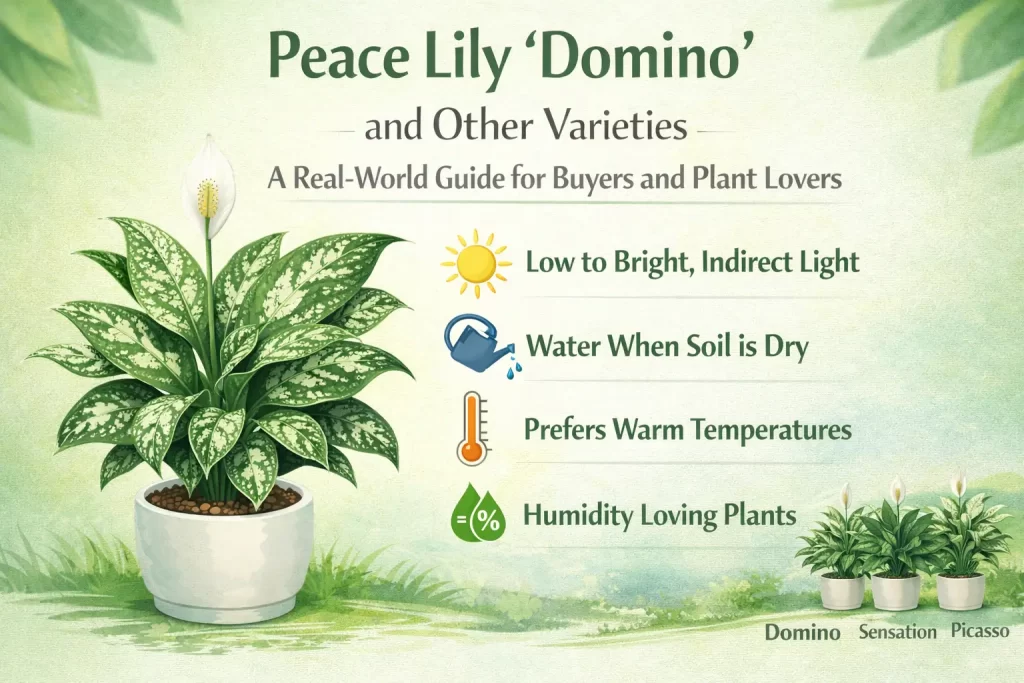
This is where most people make mistakes. Domino needs bright, indirect light to look its best. A spot near a bright window is usually ideal, as long as direct afternoon sun does not scorch the leaves.
If your Domino starts producing mostly green leaves, that is often a sign that it needs more light. It may still be alive, but it is no longer showing the feature you bought it for.
Watering
Keep the soil lightly moist, but not wet. A good rule is to water when the top inch of soil feels dry. Peace lilies are known for drooping when thirsty, but that does not mean you should keep the pot constantly soaked.
Overwatering is a bigger problem than underwatering for many indoor growers. If the roots sit in soggy soil for too long, the plant may develop yellow leaves, mushy roots, or rot.
Humidity and Temperature
Domino enjoys average to slightly humid indoor conditions. Most normal home temperatures work well. If your indoor air is very dry, you may notice crispy brown edges on the leaves.
Bathrooms with good light, kitchens, and rooms with moderate humidity often suit peace lilies well. In drier spaces, even simple changes like grouping plants together can help.
Soil
Use a well-draining indoor potting mix. Heavy soil that stays compact and wet for too long can cause root problems. The goal is moisture retention with enough air around the roots.
Fertilizer
Feed lightly during the growing season. Too much fertilizer can stress the plant, especially a variegated one. A gentle feeding schedule works better than aggressive feeding.
Common Problems and Simple Fixes
| Problem | Likely Cause | What to Do |
|---|---|---|
| Leaves turning greener | Not enough light | Move to brighter indirect light |
| Yellow leaves | Overwatering | Let soil dry slightly before watering again |
| Brown tips | Dry air or mineral-heavy water | Increase humidity or use filtered water |
| No flowers | Low light or weak feeding | Improve light and feed lightly during growth |
| Drooping leaves | Usually thirst, sometimes root stress | Check soil moisture and root condition |
Mistakes Beginners Make With Domino
Domino is not a difficult plant, but it is often misunderstood. These are the most common beginner mistakes:
- Treating it like a deep shade plant
- Overwatering because peace lilies are known to like moisture
- Expecting it to grow as fast as a standard green variety
- Ignoring leaf color changes that signal a light issue
- Buying it for looks without understanding what keeps those looks stable
The biggest mindset shift is this: Domino is still beginner-friendly, but it is less forgiving than the average peace lily. Once you understand that, it becomes much easier to care for properly.
Is Peace Lily “Domino” Worth Buying?
Yes, for the right person and the right environment.
If you care about appearance and want a peace lily that stands out from the usual green houseplants, Domino offers excellent visual value. It looks more premium and often feels more special in indoor styling.
But it is not the best choice for every home. If your room is quite dark and you want a truly low-effort plant, a classic green peace lily such as Mauna Loa may be the smarter option.
Domino is worth it if:
- You want something more decorative than a standard peace lily
- You have bright, indirect light available
- You are comfortable paying a bit more attention to care
Domino may not be ideal if:
- Your space is very low light
- You want the fastest growth possible
- You want the most forgiving variety with the least maintenance
Frequently Asked Questions
Is Domino peace lily rare?
It is not extremely rare, but it is less common than standard peace lily varieties. In many plant shops, it is seen as a more decorative or premium choice.
Does Domino grow slower than a regular peace lily?
Yes. Because of variegation, it usually grows more slowly than all-green varieties.
Can Domino survive in low light?
It can survive, but it often loses the white variegation that makes it appealing. Bright, indirect light is much better if you want it to keep its character.
Is Domino beginner-friendly?
Yes, but with one important condition: you need to understand its light needs. It is still manageable for beginners, just slightly less forgiving than a regular peace lily.
Which peace lily variety is easiest to care for?
For most beginners, a classic green variety such as Mauna Loa is the easiest choice because it tolerates lower light better and grows more predictably.
Final Thoughts
Peace Lily “Domino” sits in a very appealing middle ground. It is more stylish than a standard peace lily, but still practical enough for many indoor growers. It gives you the decorative value of variegated foliage without demanding the level of care that some rare collector plants need.
The key is to treat it according to what it is, not according to what people assume all peace lilies are. Give it bright, indirect light, avoid soggy soil, and expect slightly slower growth. Do that, and Domino can become one of the most rewarding indoor plants in your home.
If you want the easiest peace lily possible, go with a classic green variety. If you want something more distinctive and you have the right light, Domino is absolutely worth considering.