
Variegated Swiss Cheese Plant: Complete Guide for Care, Types, and Buying
Quick Summary
- Variegated Swiss cheese plants are rare forms of Monstera deliciosa with white, cream, or yellow patterns.
- The two most popular types are Monstera Albo Variegata and Monstera Thai Constellation.
- They need bright indirect light, careful watering, airy soil, and patience.
- Common problems include browning leaves, reversion, slow growth, and root rot.
- Buyers should check the roots, node, variegation pattern, and overall plant health before purchasing.
Why Everyone Is Obsessed With Variegated Monstera
If you have spent even a little time around plant lovers, you have probably noticed one plant stealing all the attention. The variegated Swiss cheese plant is not just another houseplant. It is a statement piece.
What makes it special is the contrast. Deep green leaves mixed with creamy white, yellow, or pale patterns make every leaf look unique. No two plants are exactly the same, and that unpredictability is part of the appeal.
But here is the reality many beginners do not hear early enough. These plants are not just beautiful. They are also slower, more sensitive, and usually more expensive than regular monstera plants.
This guide will help you understand what a variegated Swiss cheese plant is, how to care for it, which types are popular, what problems to expect, and what to check before buying one.
What Is a Variegated Swiss Cheese Plant?
A variegated Swiss cheese plant is a form of Monstera deliciosa where parts of the leaves have less chlorophyll. Chlorophyll is what gives leaves their green color and helps the plant produce energy through photosynthesis.
Because the white or cream parts of the leaf cannot photosynthesize as efficiently as the green areas, variegated monstera plants often grow more slowly than regular green monstera plants.
This explains many of their care needs. They usually require brighter indirect light, careful watering, and a stable indoor environment.
Popular Types of Variegated Swiss Cheese Plants
| Type | Appearance | Best For | Care Difficulty |
|---|---|---|---|
| Monstera Albo Variegata | Bold white patches, marbled leaves, sometimes half white leaves | Collectors who want dramatic variegation | Moderate to difficult |
| Monstera Thai Constellation | Creamy speckled variegation across the leaves | Beginners who want a more stable variegated monstera | Moderate |
| Monstera Aurea | Yellow or golden variegation | Collectors looking for a rarer form | Moderate to difficult |
Monstera Albo Variegata
Monstera Albo Variegata is one of the most wanted variegated Swiss cheese plants. It is known for its bold white patches and unpredictable patterns. Some leaves may have small streaks, while others may appear almost half white.
This variety is loved because every leaf feels like a surprise. However, it can also be more challenging to maintain because its variegation is not always stable.
What to Know Before Buying Monstera Albo
- It may revert and start producing fully green leaves.
- Leaves with too much white can brown more easily.
- It usually grows slower than a regular monstera.
- Cuttings should have a healthy node and visible variegation.
Monstera Thai Constellation
Monstera Thai Constellation is another popular variegated form. Unlike Albo, its variegation is usually more stable. The leaves often have creamy speckles that look like stars scattered across the surface.
This variety is often a better option for people who want a variegated monstera but do not want the stress of unstable variegation.
Why People Choose Thai Constellation
- Its variegation is more consistent.
- It is less likely to fully revert.
- It has a softer, speckled appearance.
- It can be easier for beginners compared with Albo.
Light Requirements
Light is one of the most important parts of caring for a variegated Swiss cheese plant. Because the pale parts of the leaves contain less chlorophyll, the green parts need enough light to support the whole plant.
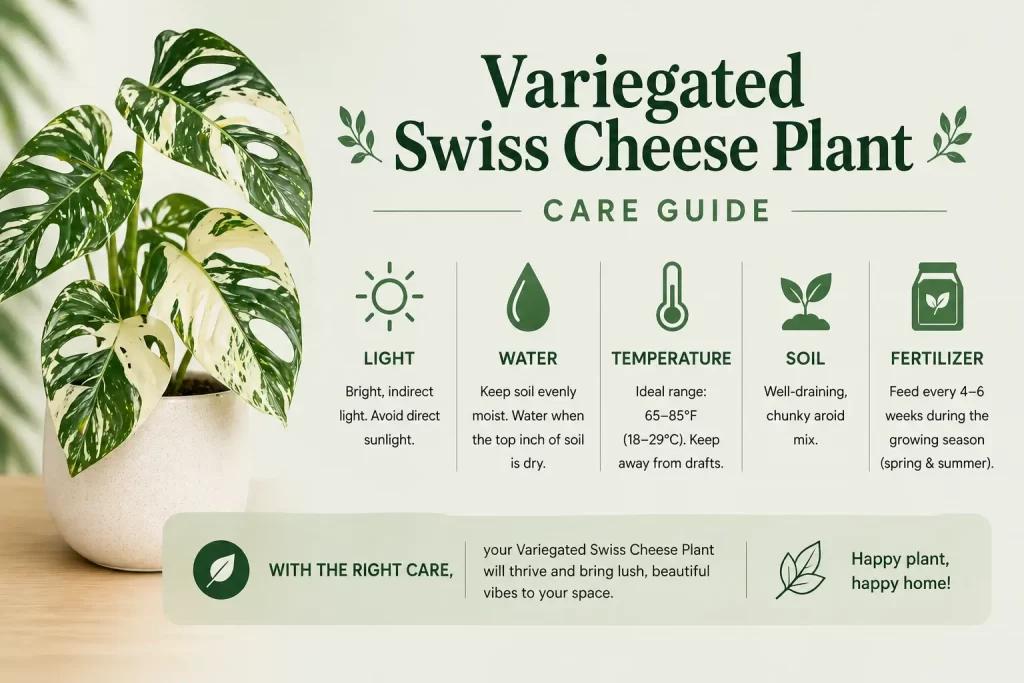
The best light condition is bright indirect light. Place the plant near a bright window, but avoid harsh direct sunlight during the hottest part of the day.
Signs Your Plant Needs More Light
- New leaves are smaller than older leaves.
- The plant grows very slowly during the growing season.
- Leaves have fewer splits or holes.
- The plant starts producing mostly green leaves.
Watering Requirements
Overwatering is one of the biggest mistakes people make with variegated monstera plants. These plants like moisture, but they do not like sitting in wet soil.
A simple rule is to water when the top 2 to 3 inches of soil feel dry. Always use a pot with drainage holes so excess water can escape.
| Problem | Possible Cause | What to Do |
|---|---|---|
| Yellow leaves | Overwatering or poor drainage | Check soil moisture and roots before watering again |
| Drooping leaves | Underwatering, overwatering, or stress | Check the soil before deciding what the plant needs |
| Mushy stem | Possible root rot | Remove from pot and inspect roots immediately |
Best Soil Mix
A variegated Swiss cheese plant grows best in a chunky, airy soil mix. Regular dense potting soil can hold too much water and may cause root problems.
A good soil mix can include:
- Indoor potting soil
- Perlite
- Orchid bark
- Coco coir or peat moss
This kind of mix helps keep moisture around the roots while still allowing air to move through the soil.
Humidity and Temperature
Variegated monstera plants usually prefer moderate to high humidity. A humidity range of around 50 to 70 percent is helpful, especially if your home is dry.
They also prefer warm indoor temperatures. Avoid placing the plant near cold drafts, air conditioners, heaters, or windows that become very cold at night.
Ways to Improve Humidity
- Use a humidifier near the plant.
- Group houseplants together.
- Place the plant in a naturally humid room with good light.
- Avoid placing it near heating vents.
Common Problems With Variegated Swiss Cheese Plants
Browning White Leaves
The white parts of the leaves are more delicate than the green parts. Browning can happen because of strong direct sunlight, low humidity, inconsistent watering, or mineral buildup in the water.
To reduce browning, keep the plant in bright indirect light, maintain steady humidity, and avoid letting the soil stay too wet or too dry for long periods.
Reversion
Reversion happens when a variegated plant starts producing fully green leaves. This is most common in Monstera Albo Variegata.
If the plant keeps producing green leaves, prune back to a node that still has variegation. This may encourage future growth with better color balance.
Slow Growth
Slow growth is normal for variegated monstera plants, but extremely slow growth can mean the plant needs better light, healthier roots, or a more suitable soil mix.
Buying Guide: What to Check Before You Purchase
Because variegated Swiss cheese plants can be expensive, it is important to inspect them carefully before buying. A beautiful leaf is not enough. You need to check the whole plant.
Look For These Signs
- Healthy roots if visible
- A strong stem
- Balanced variegation with both green and pale areas
- No mushy spots
- No signs of pests
- A visible node if buying a cutting
Be Careful With These Red Flags
- Leaves that are completely white with no green
- Very cheap listings that seem unrealistic
- Cuttings with no node
- Wet, black, or mushy stems
- Sellers who cannot provide clear photos
Is a Variegated Swiss Cheese Plant Right for You?
This plant is a good fit if you enjoy caring for plants closely and can provide the right environment. It is not the best choice for someone who wants a very easy, fast-growing houseplant.
| Good Choice If | Not Ideal If |
|---|---|
| You have bright indirect light | Your home is very dark |
| You enjoy slow plant growth | You want fast results |
| You can monitor watering carefully | You often overwater plants |
| You are comfortable paying more for rare plants | You want a low-cost beginner plant |
Quick Care Checklist
- Place in bright indirect light.
- Water only when the top 2 to 3 inches of soil are dry.
- Use a chunky, well-draining soil mix.
- Keep humidity moderate to high.
- Inspect regularly for browning, pests, and reversion.
- Do not panic if growth is slower than a regular monstera.
Frequently Asked Questions
Is a variegated Swiss cheese plant rare?
Yes, many variegated forms are considered rare because their patterns are harder to produce and maintain compared with regular green monstera plants.
Why is my variegated monstera turning brown?
Browning often happens because of harsh sunlight, low humidity, inconsistent watering, or stress. The white parts of the leaves are especially sensitive.
Can a variegated monstera lose its variegation?
Yes. Some types, especially Monstera Albo Variegata, can start producing green leaves. This is called reversion.
Is Monstera Thai Constellation easier than Monstera Albo?
In many cases, yes. Thai Constellation usually has more stable variegation, while Albo can be more unpredictable.
Should I buy a cutting or a full plant?
A full plant is usually safer for beginners. A cutting can be cheaper, but it carries more risk, especially if the node or roots are weak.
Final Thoughts
Variegated Swiss cheese plants are beautiful, rare, and rewarding when cared for properly. They can become the centerpiece of an indoor plant collection, but they need more attention than a regular monstera.
If you can provide bright indirect light, careful watering, and a stable environment, this plant can be a wonderful long-term addition to your home.
If you are still unsure, start with a regular monstera first. Once you understand its growth habits, moving to a variegated form will feel much easier.