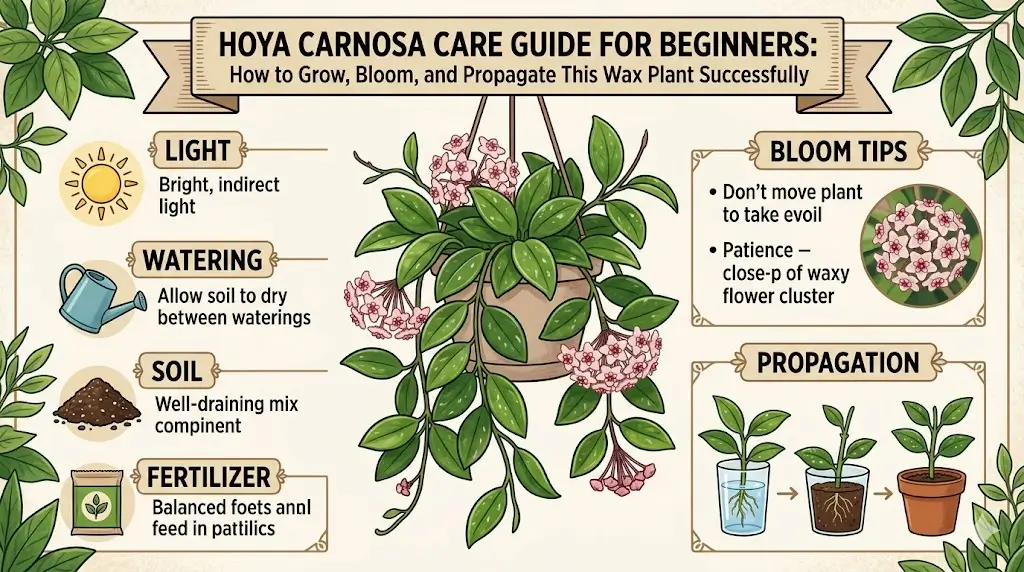

Hoya Carnosa Care Guide for Beginners: How to Grow, Bloom, and Propagate This Wax Plant Successfully
Hoya carnosa, also known as the wax plant, is one of the most rewarding indoor plants you can grow. It is beginner friendly, attractive in almost any room, and capable of producing beautiful clusters of star shaped flowers when cared for well. If you want a practical guide that helps you keep your plant healthy, encourage blooms, and avoid common mistakes, this article will walk you through everything you need to know in a simple, useful way.
Quick Summary
| Best for | Beginners and indoor plant lovers |
|---|---|
| Light | Bright indirect light |
| Watering | Let the soil dry out between watering |
| Soil | Well draining, airy mix |
| Blooming | Needs patience, light, and steady care |
| Propagation | Easy through stem cuttings |
| Common issues | Yellow leaves, overwatering, lack of blooms |
If you follow just one rule, make it this: do not overwater your Hoya carnosa. Most problems with this plant start there.
Who This Guide Is For
This guide is written for beginners and casual indoor plant owners who want clear, practical advice without unnecessary jargon. If you have recently bought a Hoya carnosa, received one as a gift, or have been struggling to make yours grow or bloom, this article is for you.
By the end of this guide, you should know what your plant needs, how to avoid the most common care mistakes, and what to do if it is not growing the way you hoped.
What Makes Hoya Carnosa So Popular
Hoya carnosa is often called the wax plant because of its thick, glossy leaves and its flower clusters that look almost unreal. The blooms are usually star shaped, slightly waxy in appearance, and often lightly fragrant.
People love this plant for a few simple reasons. It is low maintenance, attractive year round, adaptable to indoor conditions, and long lived when cared for properly. It also looks beautiful in hanging baskets, on shelves, or trailing from a plant stand.
It is not the fastest growing houseplant, but that is part of its appeal. Once you understand its rhythm, it becomes a reliable and satisfying plant to keep.
Light Requirements for Healthy Growth
If you want your Hoya carnosa to do well, light is one of the most important factors to get right. This plant prefers bright indirect light. In simple terms, that means a bright room near a window where the sun is filtered or gentle.
Morning sunlight is usually well tolerated and can actually help the plant grow and bloom. Harsh afternoon sunlight, especially in very hot climates, may scorch the leaves if the plant is placed too close to the glass.
Best placement ideas
- Near an east facing window with soft morning light
- A little back from a south or west facing window with filtered light
- In a bright room where the plant gets several hours of indirect brightness each day
If your Hoya is not growing much or has never flowered, there is a good chance it needs more light. Many people keep it alive in low light, but low light rarely gives the best results.
How Often to Water Hoya Carnosa
Hoya carnosa stores some moisture in its thick leaves, so it does not like to stay wet for long periods. This is why overwatering is such a common issue. Instead of watering on a strict schedule, check the soil first.
A good rule is to water only when the top part of the soil has dried out well. In many homes, that may mean watering every 7 to 14 days, but the actual timing depends on temperature, light, humidity, pot size, and the type of soil mix you use.
Signs of overwatering
- Yellow leaves
- Soft stems
- Mushy roots
- A sour smell from the pot
Signs of underwatering
- Wrinkled or thinner leaves
- Very dry soil pulling away from the pot
- Drooping growth
If you are ever unsure, it is generally safer to wait a little longer than to water too soon.
The Best Soil Mix for Hoya Carnosa
Hoya roots need oxygen as much as they need moisture. A dense, heavy soil mix can stay wet too long and lead to root problems. That is why a loose, airy, well draining potting mix is best.
Simple soil mix recipe
| Ingredient | Purpose |
|---|---|
| Potting soil | Provides base nutrition and structure |
| Perlite | Improves drainage and airflow |
| Orchid bark or coco chips | Keeps the mix chunky and breathable |
A simple blend of 40 percent potting soil, 30 percent perlite, and 30 percent bark works well for many growers. The goal is to keep moisture available without trapping too much water around the roots.
Temperature and Humidity
Hoya carnosa is quite adaptable indoors and usually grows well in normal home conditions. It prefers temperatures between 18 and 30 degrees Celsius and does best when protected from cold drafts and sudden temperature drops.
It can tolerate average indoor humidity, which is one reason it is such a popular houseplant. That said, moderate humidity often supports better growth. If your indoor air is very dry, grouping plants together can help create a more comfortable microclimate.
How to Encourage Hoya Carnosa to Bloom
One of the most exciting things about growing a Hoya carnosa is getting it to flower. The challenge is that blooming often requires patience. Some plants bloom fairly young, while others take a couple of years to mature enough.
Main factors that support blooming
- Bright indirect light
- A mature plant
- Consistent care
- A slightly root bound pot
- Avoiding constant changes in placement
One important tip that many beginners miss is this: do not remove the old flower spurs. These short stalks are where the plant often blooms again in future cycles. Cutting them off can delay future flowers.
Many plant owners also notice that their Hoya starts blooming when they stop overmanaging it. A plant that gets bright light, careful watering, and a stable environment often performs better than one that is constantly being moved, repotted, or watered too often.
Fertilizing Your Wax Plant
Hoya carnosa is not a heavy feeder, but light feeding during active growth can help support healthier leaves and stronger vines. A balanced liquid fertilizer used once a month during the growing season is usually enough.
Reduce or stop fertilizing in cooler months when growth naturally slows down. Overfertilizing can damage roots and create more problems than it solves.
Simple fertilizer approach
| Season | What to Do |
|---|---|
| Spring and summer | Feed lightly once a month |
| Autumn | Reduce feeding as growth slows |
| Winter | Pause or feed very sparingly |
How to Propagate Hoya Carnosa
Propagation is one of the easiest and most enjoyable parts of growing this plant. Hoya carnosa can be propagated from stem cuttings, and many beginners have success either in water or directly in a light soil mix.
Step by step propagation method
- Take a healthy stem cutting with at least one node.
- Remove any lower leaves that would sit in water or soil.
- Place the node in water or a lightly moist propagation mix.
- Keep the cutting in bright indirect light.
- Wait for roots to develop before potting up if you started in water.
The node is the most important part. Without it, roots will not form properly. Be patient, because rooting time can vary depending on warmth, light, and the time of year.
Common Problems and How to Fix Them
| Problem | Likely Cause | What to Do |
|---|---|---|
| Yellow leaves | Overwatering | Let the soil dry more between watering and check drainage |
| No flowers | Low light, immature plant, or too much interference | Increase light, be patient, and avoid cutting flower spurs |
| Slow growth | Low light or poor feeding routine | Move to a brighter spot and feed lightly during active growth |
| Leaf drop | Stress from sudden changes | Keep conditions stable and avoid frequent relocation |
| Wrinkled leaves | Underwatering or root trouble | Check the roots and adjust watering based on soil dryness |
Best Pot and Placement Ideas
Hoya carnosa looks especially attractive when allowed to trail naturally. Hanging baskets, wall planters, or elevated shelves all work well. Choose a pot with proper drainage and avoid using decorative containers that trap excess water unless you use them only as an outer cover pot.
It also tends to do well when slightly root bound, so there is no need to repot too often. In fact, repotting too frequently can interrupt growth and delay blooming.
Beginner Mistakes to Avoid
- Watering on a rigid schedule without checking the soil
- Using dense soil with poor drainage
- Keeping the plant in a dim corner
- Repotting too frequently
- Removing flower spurs after blooming
- Expecting fast flowers from a very young plant
A lot of Hoya success comes down to restraint. Give it enough light, water it carefully, and avoid doing too much.
Frequently Asked Questions
How often should I water Hoya carnosa?
Water when the soil has dried out well, not on a fixed schedule. In many homes this is about every 7 to 14 days, but it depends on your environment.
Can Hoya carnosa grow in low light?
It can survive in lower light, but it usually grows more slowly and is far less likely to bloom. Bright indirect light is the better option.
How long does it take for a Hoya carnosa to flower?
Some plants bloom within a year or two, while others take longer. Maturity, light, and consistent care all play a role.
Is Hoya carnosa a good beginner plant?
Yes. It is one of the best houseplants for beginners because it is forgiving, attractive, and does not demand constant attention.
Should I mist my Hoya carnosa?
Misting is not essential. Average indoor humidity is usually enough, though moderate humidity can support better growth.
Final Thoughts
Hoya carnosa is a plant that rewards patience. It may not always grow quickly, but it is dependable, beautiful, and deeply satisfying to care for once you understand what it likes. Give it bright indirect light, let the soil dry between watering, keep it in a breathable mix, and avoid overhandling it.
If you do that, your wax plant has every chance to thrive and eventually reward you with the kind of blooms that make people stop and look twice.
Final Self Check Before Publishing
- Does this article clearly solve a real reader problem?
- Is the advice useful, accurate, and easy to follow?
- Would a beginner feel more confident after reading it?
- Is this something you would proudly publish under your name?
Create content that a real human would thank you for, and Google will usually have a good reason to trust it too.