
Hoya Kerrii Care Guide (Heart-Shaped Hoya): The Truth, Care Tips, and Why Yours Isn’t Growing
Quick Summary
| Plant type | Slow-growing succulent vine with heart-shaped leaves |
| Most important fact | Most single-leaf plants sold in pots will never grow into a full vine |
| Best light | Bright indirect light |
| Watering rule | Water only when the soil dries out fully |
| Biggest risk | Overwatering and root rot |
| Propagation requirement | A node is required for new growth |
Introduction: Why This Plant Confuses So Many People
Bought a cute heart-shaped plant and expected it to grow into a lush vine, but months later nothing has changed?
You are not alone.
The Hoya kerrii, often called the heart-shaped hoya, is one of the most misunderstood houseplants. It is sold as a romantic gift, but it is rarely explained properly. Many plant owners end up frustrated because their plant simply does not grow.
This guide clears up the confusion and gives you practical care advice you can actually use.
By the end of this article, you will understand how this plant grows, how to care for it correctly, what mistakes to avoid, and whether your plant can grow at all.
What Is Hoya Kerrii?
Hoya kerrii is a tropical succulent vine native to Southeast Asia. It belongs to the Hoya family, which is known for thick, waxy leaves and slow-growing indoor plants.
What makes this plant so popular is its unique appearance. Each leaf looks like a green heart, which is why it is often sold as a gift plant for birthdays, anniversaries, and Valentine’s Day.
Hoya kerrii is appreciated for:
- Thick heart-shaped leaves
- Drought tolerance compared to many houseplants
- Long lifespan with proper care
- Decorative value in small spaces
However, there is one detail that most sellers do not explain clearly enough: there are two very different forms of Hoya kerrii sold in the market.
- A single leaf planted in soil
- A full plant with stem and nodes
This difference matters more than anything else when it comes to growth.
The Big Truth: Why Your Hoya Kerrii Is Not Growing
This is the most important thing to know before caring for a Hoya kerrii.
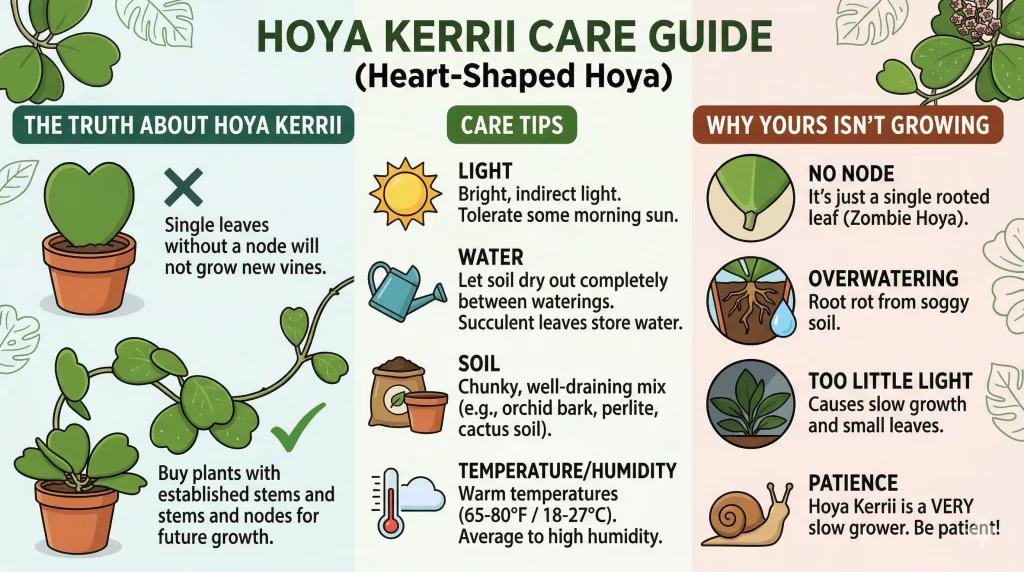
If you bought a single heart-shaped leaf, it will most likely never grow into a full vine.
The reason is simple. A leaf alone usually does not include a node. A node is the part of the plant where new stems and leaves develop. Without a node, the leaf may stay green and healthy for a very long time, but it will not produce new growth.
That means:
- No new vine
- No new leaves
- No real plant development
This does not mean you failed. It means the plant was sold more as a decorative cutting than as a growing plant.
If your Hoya kerrii has a visible stem or growth point, it has a chance to grow. If it is only a single rooted leaf, it is best to enjoy it as a long-lasting novelty plant rather than expecting it to become a trailing vine.
Hoya Kerrii Care Guide
Light Requirements
Hoya kerrii grows best in bright indirect light. It likes a well-lit area but does not enjoy intense harsh afternoon sun, especially through hot glass windows.
Good placement options include:
- Near an east-facing window
- Near a bright north-facing window
- A few feet away from a stronger south-facing window
In many Indian homes, bright filtered light works very well.
Too little light can lead to:
- No growth
- Weak stems
- Long gaps between leaves
Too much direct sun can cause leaf stress or burn.
Watering
Overwatering is the most common reason Hoya kerrii struggles indoors.
This plant stores moisture in its thick leaves, so it is better to water a little less often than too often. Always let the soil dry out well before watering again.
A simple watering rule is this: water only when the soil feels dry.
You can check by placing your finger into the top layer of soil. If it still feels damp, wait a few more days.
| Season | General Watering Pattern |
|---|---|
| Summer | About every 7 to 10 days, depending on heat and airflow |
| Winter | About every 2 to 3 weeks, depending on indoor conditions |
These are only rough guidelines. Your actual schedule will depend on pot size, soil mix, humidity, and light levels.
Soil Mix
Hoya kerrii needs a light, airy, and well-draining potting mix. Heavy compact soil holds too much moisture around the roots and increases the risk of rot.
A good mix can include:
- Regular potting soil
- Perlite
- Orchid bark or coco chips
A practical ratio is:
- 50% potting soil
- 25% perlite
- 25% orchid bark or chunky amendment
This allows excess water to drain faster and gives the roots better airflow.
Temperature and Humidity
Hoya kerrii prefers warm conditions and generally does well in normal indoor environments.
- Ideal temperature range: 18°C to 30°C
- Protect from cold drafts and sudden temperature drops
- Average room humidity is usually enough
You do not need to mist this plant regularly. Stable conditions matter more than high humidity tricks.
Why Hoya Kerrii Grows So Slowly
Even when you do everything right, Hoya kerrii is still a slow grower.
This is normal.
It naturally grows at a slower pace because it stores water in thick leaves and often focuses first on root development before putting energy into visible new growth.
That means you may only see a few new leaves in a year, especially indoors. Many plant owners think something is wrong when the plant is simply behaving as expected.
Patience is part of successful Hoya kerrii care.
Common Problems and How to Fix Them
| Problem | Likely Cause | What to Do |
|---|---|---|
| No growth | Single leaf with no node, or not enough light | Check for a node and move the plant to brighter indirect light |
| Yellow leaves | Overwatering | Let the soil dry fully and improve drainage |
| Wrinkled leaf | Underwatering or damaged roots | Review watering habits and inspect roots if needed |
| Mushy leaf or soft base | Root rot from too much moisture | Remove rotten parts and repot in fresh, airy soil |
| Leaf burn | Too much harsh direct sun | Move to bright but filtered light |
Propagation: What Actually Works
Propagation is possible, but only when a cutting includes a node.
If you try to propagate only a leaf without a node, it may survive and even root, but it will not become a growing vine.
To propagate Hoya kerrii successfully:
- Take a stem cutting with at least one healthy node
- Place it in water or a light propagation medium
- Keep it in bright indirect light
- Wait for roots to develop before potting up if needed
Always make sure the cutting is healthy and not stressed. Propagation is slower than with many other common houseplants, so patience is important here too.
Is Hoya Kerrii Toxic?
Hoya kerrii is generally considered mildly toxic to pets if ingested.
It is not usually described as highly dangerous, but chewing on the plant may cause stomach upset in cats or dogs.
If you have curious pets, it is best to keep the plant on a shelf, plant stand, or in another spot that is harder to access.
Frequently Asked Questions
How fast does Hoya kerrii grow?
Very slowly. Even in ideal conditions, it may only produce a few leaves per year.
Can a single leaf grow into a full plant?
Usually no. It needs a node to produce new growth.
How often should I water Hoya kerrii?
Only when the soil has dried out well. Avoid watering on a strict calendar without checking the soil first.
Why is my Hoya kerrii not growing?
The two most common reasons are that it is a single leaf without a node or that it is not getting enough bright light.
Can Hoya kerrii grow indoors in India?
Yes. It can do well indoors in India if given bright indirect light, warm temperatures, and a fast-draining soil mix.
Final Thoughts: What Most People Get Wrong
Hoya kerrii is not a difficult plant, but it is often misunderstood.
The biggest issues usually come from unrealistic expectations, poor seller information, and overwatering. Many people think their plant is failing when in reality it is either a decorative single leaf or simply a naturally slow grower.
If you remember one thing from this guide, let it be this: a single leaf is decorative, but a node is what makes real growth possible.
Reader Self-Check
After reading this guide, you should be able to:
- Tell whether your Hoya kerrii can actually grow
- Understand the correct light and watering routine
- Choose a better soil mix
- Identify common problems early
- Avoid the most common care mistakes
One Simple Rule
Create content that genuinely helps someone understand their plant better and solve a real problem. When readers feel informed, relieved, and confident, search performance often follows naturally.