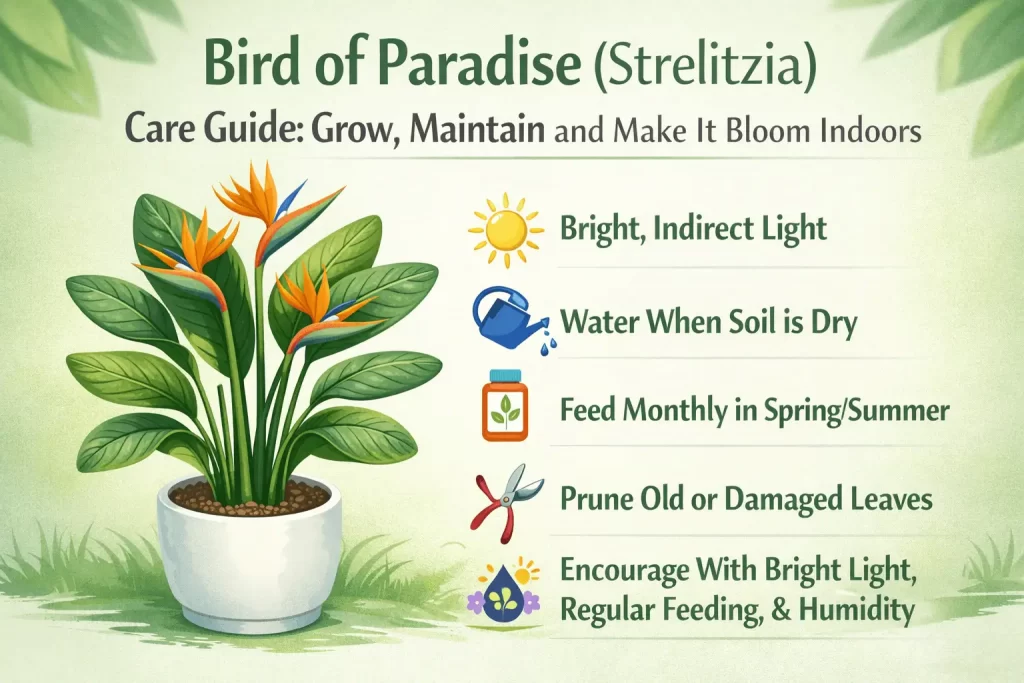

Bird of Paradise (Strelitzia) Care Guide: Grow, Maintain and Make It Bloom Indoors
Quick Summary
- Bird of Paradise, also known as Strelitzia, is a tropical plant known for its bold leaves and exotic flowers.
- It thrives in bright sunlight and needs consistent but controlled watering.
- Most indoor plants do not flower because they do not get enough light or are not mature yet.
- Well-draining soil and the right pot size are essential for healthy growth.
- In Indian climates, humidity and sunlight management are often the biggest success factors.
- With the right care, it becomes a striking statement plant for homes and offices.
What This Guide Will Help You Do
If you are here, you are likely dealing with one of these common situations. Your Bird of Paradise may not be growing well, it may look healthy but refuse to flower, or you may be planning to buy one and want to avoid beginner mistakes.
This guide is written for beginners and intermediate plant lovers, especially those growing Bird of Paradise in warm climates like India.
By the end of this article, you will know how to care for it properly, what mistakes to avoid, how to encourage blooming, and whether this plant is the right fit for your home or office.
What Is Bird of Paradise (Strelitzia)?
Bird of Paradise is a tropical plant native to South Africa. Its name comes from its flower, which resembles a bird in flight. It is one of the most visually impressive ornamental plants and is widely loved for both its flowers and dramatic foliage.
The most popular varieties include Strelitzia reginae, which is smaller and more likely to flower, and Strelitzia nicolai, which grows much larger and is usually grown for its foliage.
| Variety | Main Feature | Best Use |
|---|---|---|
| Strelitzia reginae | Produces colorful flowers | Indoor and outdoor decorative plant |
| Strelitzia nicolai | Large tropical foliage | Statement plant for spacious interiors and gardens |
Bird of Paradise is often used as a decorative indoor plant, a tropical landscaping choice, and a statement piece because of its large, banana-like leaves.
Light Requirements
If there is one factor that matters most, it is light. Bird of Paradise needs bright conditions to thrive. Without enough light, growth slows down, leaves may weaken, and flowering becomes unlikely.
The plant does best in bright indirect sunlight for most of the day, though it can also handle some direct morning sun. Indoors, south-facing or west-facing windows are usually the best choices.
In many Indian homes, placing the plant near a bright balcony or close to a large window works better than keeping it deeper inside a room.
| Light Condition | Effect on Plant |
|---|---|
| Bright indirect light | Healthy growth and better chance of flowering |
| Some direct morning sun | Supports strong growth |
| Low light | Slow growth, drooping leaves, no flowers |
Watering: Balance Is Key
Overwatering is one of the most common reasons Bird of Paradise struggles indoors. This plant likes moisture, but it does not like sitting in soggy soil.
A good rule is to water when the top 2 to 3 inches of soil feel dry. Always make sure extra water drains out of the pot. During cooler months, watering should be reduced because the soil stays moist longer.
Yellow leaves often point to overwatering, while brown edges may suggest underwatering or dry air.
In hot climates, the plant may need watering more often, but you should always check the soil before adding more water.
Soil and Pot Requirements
Bird of Paradise needs well-draining soil to stay healthy. Heavy soil that holds too much water can quickly lead to root problems.
A suitable mix may include garden soil, coco peat, and perlite or coarse sand for drainage. The pot should always have drainage holes.
This plant often performs better when it is slightly root-bound, so avoid moving it into an oversized pot too early. Repotting every 2 to 3 years is usually enough.
| Care Element | Recommended Option |
|---|---|
| Soil | Well-draining mix with garden soil, coco peat, and perlite or sand |
| Pot | Container with drainage holes |
| Repotting | Every 2 to 3 years |
Why Your Bird of Paradise Is Not Flowering
This is one of the biggest questions plant owners have. A healthy-looking Bird of Paradise may still refuse to bloom, especially indoors.
The most common reason is not enough light. Flowering requires strong, sustained light. Another reason is plant maturity. Many Bird of Paradise plants need several years before they are mature enough to bloom.
Over-fertilizing can also be a problem because it encourages leaf growth instead of flowers. Indoor conditions, especially in apartments with limited sunlight, can make blooming even harder.
The truth is simple. Many indoor Bird of Paradise plants never flower, and that does not mean you are failing. They are still highly attractive foliage plants.
Temperature and Humidity
Bird of Paradise prefers warm conditions and generally grows well between 18°C and 30°C. This makes it suitable for many parts of India.
It can tolerate warm weather well, but extreme heat waves or harsh dry winds may stress the plant. In dry indoor conditions, occasional misting or increasing humidity nearby can help.
Try to keep it away from direct blasts of air from air conditioners, heaters, or strong hot winds.
Fertilizer: When and How to Feed
During the active growing season, Bird of Paradise benefits from regular feeding. A balanced liquid fertilizer every 2 to 4 weeks is usually enough.
Do not overfeed the plant. Excess fertilizer can lead to salt buildup, leaf issues, and fewer flowers. In winter or during slow growth periods, reduce or stop feeding.
A simple, moderate routine is usually more effective than aggressive feeding.
Common Problems and Solutions
| Problem | Likely Cause | What to Do |
|---|---|---|
| Leaves splitting | Natural growth pattern | No action needed in most cases |
| Yellow leaves | Overwatering or poor drainage | Let soil dry more between watering and check drainage |
| Brown tips | Low humidity or inconsistent watering | Improve watering routine and humidity |
| No growth | Lack of light or nutrients | Move to a brighter spot and feed during growing season |
Do not worry about small imperfections. Bird of Paradise is a naturally rugged plant, and not every split or spot means something is seriously wrong.
Indoor Styling and Placement Ideas
Bird of Paradise is more than just a plant. It is often used as a visual focal point in interior design because of its height, structure, and lush leaves.
It looks especially good in living room corners, near large windows, on bright balconies, and in office spaces that receive good natural light.
For a cleaner look, use a simple pot design and give the plant enough space so the leaves can spread naturally. One healthy Bird of Paradise usually creates a stronger visual impact than several smaller struggling plants.
Propagation: Can You Grow More?
Bird of Paradise can be propagated, but it is not the fastest or easiest plant to multiply. The usual method is division of a mature plant.
This process takes patience and works best when the plant is healthy and well-established. For beginners, it is often better to focus first on keeping one plant strong before trying propagation.
Is Bird of Paradise Safe for Pets?
Bird of Paradise is considered mildly toxic if ingested. It may cause irritation or digestive discomfort in cats and dogs. If you have curious pets that chew on leaves, it is safer to keep the plant out of reach or choose a more pet-friendly alternative.
Is This Plant Right for You?
Bird of Paradise is a great choice if you have bright natural light, want a bold statement plant, and are willing to be patient with growth and flowering.
It may not be the best option if your home has very low light, if you want frequent blooms quickly, or if you prefer plants that need very little attention.
Final Takeaway
Bird of Paradise is not difficult to grow, but it does need the right conditions. Strong light, proper watering, and well-draining soil are the foundations of success.
If you can provide those basics, this plant can reward you with impressive foliage and, in the right conditions, beautiful flowers that make it one of the most memorable plants you can grow indoors or outdoors.
Quick Self-Check
- Is your plant getting bright light every day?
- Are you checking the soil before watering?
- Does your pot have proper drainage?
- Are you being patient with growth and flowering?
If the answer is yes to most of these, you are already doing better than many first-time plant owners.