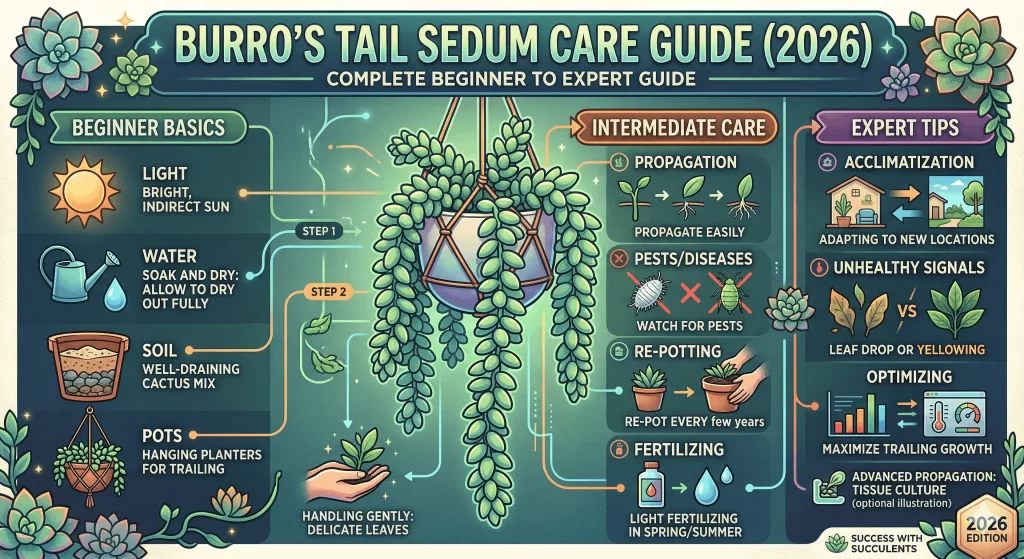

Burro’s Tail Sedum Care Guide (2026): Complete Beginner to Expert Guide
Burro’s tail sedum is one of the most attractive trailing succulents you can grow at home. Its plump, bead-like leaves and long cascading stems make it a favorite for hanging planters, shelves, and bright indoor corners. It also has a reputation for being easy to care for, but that is only partly true. While it does not need constant attention, it does need the right balance of light, watering, and handling.
This guide is written for beginners, plant lovers, and anyone who wants a healthy Burro’s tail without learning through costly mistakes. You will learn what this plant needs, what usually goes wrong, and how to keep it looking full, strong, and beautiful over time.
Quick Summary
| Plant name | Burro’s tail sedum |
|---|---|
| Scientific name | Sedum morganianum |
| Plant type | Trailing succulent |
| Best placement | Bright indoor space with indirect light |
| Light needs | Bright indirect sunlight, with some gentle morning sun if available |
| Watering | Usually every 2 to 3 weeks, only when soil is fully dry |
| Soil | Fast-draining succulent or cactus mix |
| Common issue | Leaf drop from overhandling or overwatering |
| Best for | Beginners, indoor plant lovers, hanging planters |
What Is Burro’s Tail Sedum?
Burro’s tail, also called donkey tail succulent, is a trailing succulent known for its thick stems covered in tightly packed, fleshy leaves. As it matures, the stems spill downward and create a soft, full look that works especially well in hanging containers.
It is native to Mexico and is widely grown as an ornamental houseplant. Its beauty is a big reason for its popularity, but there is something important many new plant owners do not realize at first. This plant is delicate. The leaves fall off very easily when touched, moved, or bumped. That does not make it hard to own, but it does mean gentle handling is part of good care.
Why People Love This Plant
- It has a unique trailing look that stands out in any room.
- It does not need frequent watering.
- It works beautifully in hanging baskets and decorative planters.
- It can be propagated from fallen leaves.
- It adds texture and softness to indoor spaces.
If you want a plant that looks impressive without demanding daily care, Burro’s tail is a strong choice.
Light Requirements
Light is one of the most important parts of Burro’s tail care. This plant grows best in bright indirect light. A spot near an east-facing or south-facing window usually works well, especially if the harsh afternoon sun is filtered.
If the plant gets too little light, the stems may stretch, the leaves may look sparse, and the overall shape can become weak and leggy. If it gets too much intense sun all at once, the leaves may scorch or lose their healthy appearance.
Best light setup
- Bright indirect sunlight for most of the day
- A little gentle morning sun can be beneficial
- Filtered sunlight indoors is usually ideal
Signs your plant needs more light
- Long stretched stems
- Leaves spaced farther apart than normal
- Paler color or weak growth
If you move the plant to a brighter area, do it gradually so it can adjust without stress.
How Often to Water Burro’s Tail
This is where most people make mistakes. Burro’s tail stores water in its leaves, so it does not need frequent watering. In fact, too much water is far more dangerous than too little.
A simple rule works best: water only when the soil is completely dry. In many homes, that means watering every 2 to 3 weeks, but your exact schedule can vary depending on heat, humidity, light, pot size, and season.
How to water correctly
- Check the soil before watering.
- If the top 2 inches feel dry, water thoroughly.
- Let excess water drain out fully.
- Do not water again until the soil has dried completely.
Signs of overwatering
- Yellowing leaves
- Mushy stems
- Rot near the base
- Leaves dropping after becoming soft
Signs of underwatering
- Wrinkled leaves
- Shriveled appearance
- Dry and thin stems
If you are unsure, wait a little longer. Burro’s tail usually recovers better from slight dryness than from soggy soil.
Best Soil for Burro’s Tail Sedum
Regular garden soil or heavy potting mix can hold too much moisture for this plant. Burro’s tail needs fast-draining soil that allows water to pass through quickly and air to reach the roots.
A cactus or succulent mix is usually the easiest and safest option. You can improve drainage even more by mixing in perlite, pumice, or coarse sand.
Good soil characteristics
- Light and airy texture
- Fast drainage
- Does not stay wet for long
Healthy roots depend heavily on the soil. Even perfect watering habits may not save a plant sitting in dense, waterlogged mix.
Choosing the Right Pot
The right pot helps prevent overwatering problems and also improves how the plant looks as it grows. A shallow pot with drainage holes is usually best. Since Burro’s tail is shallow-rooted, it does not need a very deep container.
Best pot features
- Drainage hole at the bottom
- Shallow to medium depth
- Stable enough to support trailing growth
Hanging pots and elevated planters work especially well because they let the stems cascade naturally.
Temperature and Humidity
Burro’s tail prefers mild to warm conditions and generally does well in normal indoor environments. It is not a humidity-hungry plant, so average room humidity is usually fine.
| Ideal temperature | 18°C to 28°C |
|---|---|
| Avoid | Frost, cold drafts, sudden temperature shifts |
| Humidity | Average indoor humidity is usually enough |
If temperatures fall too low, the plant can weaken quickly. If you grow it outdoors in a warm climate, protect it from heavy rain and cold nights.
How to Propagate Burro’s Tail
One of the most rewarding parts of owning Burro’s tail is that you can propagate it from leaves or stem cuttings. Since the leaves fall off easily, many growers use fallen leaves instead of throwing them away.
Leaf propagation steps
- Collect healthy leaves that have fallen off cleanly.
- Let them dry for 1 to 2 days so the ends can callus.
- Place them on top of dry succulent soil.
- Keep them in bright indirect light.
- Lightly mist only when needed until roots begin to form.
After a few weeks, tiny roots and new growth may appear. This process takes patience, but it is a great way to grow new plants from what would otherwise be lost foliage.
Stem propagation steps
- Cut a healthy stem section.
- Let the cut end dry and callus for a few days.
- Plant it in dry succulent soil.
- Wait a few days before watering lightly.
Stem propagation is often faster than leaf propagation, especially if you want a fuller pot sooner.
Common Problems and Fixes
| Problem | Likely Cause | What to Do |
|---|---|---|
| Leaves falling off | Too much handling, sudden movement, overwatering | Keep plant in a stable place, reduce touching, review watering routine |
| Mushy stems | Overwatering or poor drainage | Remove damaged parts, repot into dry fast-draining soil, water less often |
| Wrinkled leaves | Underwatering | Water thoroughly, then return to proper dry-down cycle |
| Leggy growth | Not enough light | Move to a brighter area with indirect sunlight |
| Slow growth | Low light, cold conditions, small root stress | Improve light and maintain stable warm conditions |
Indoor vs Outdoor Growing
Burro’s tail can be grown indoors or outdoors, but indoor growing is usually easier for most people. It gives you more control over watering, temperature, and light exposure.
Indoor growing benefits
- Easier protection from harsh sun and rain
- More stable temperatures
- Better for decorative placement
Outdoor growing considerations
- Works best in warm, dry climates
- Needs shelter from heavy rain
- Should not be exposed to frost
For beginners, indoor care is often the better starting point.
Real Care Tips That Make a Big Difference
Many articles cover the basics, but these practical details often make the difference between a struggling plant and a thriving one.
- Place the plant where it will not be brushed against often.
- Do not repot unless necessary because disturbance can trigger leaf drop.
- Rotate the pot occasionally for even growth, but do it gently.
- Use fallen leaves for propagation instead of seeing them as a failure.
- Choose a display spot before the stems get long, because moving mature plants can be messy.
These are simple habits, but they help preserve the plant’s full trailing appearance.
Who Should Grow Burro’s Tail?
This plant is ideal for people who want something attractive and low maintenance, but it is especially good for those who can leave a plant alone once it is placed properly. If you enjoy constantly touching, rearranging, or repotting plants, Burro’s tail may test your patience. If you prefer a set-it-and-monitor-it approach, it can be a wonderful choice.
It is a strong option for:
- Beginners learning succulent care
- Apartment dwellers with bright windows
- Plant lovers who want a hanging or trailing plant
- People looking for a decorative but manageable succulent
Frequently Asked Questions
How often should I water Burro’s tail?
Usually every 2 to 3 weeks, but only after the soil is completely dry. The best schedule is based on dryness, not the calendar alone.
Why does Burro’s tail drop leaves so easily?
The leaves are naturally delicate and detach with light pressure. Handling, repotting, moving, and overwatering can all make leaf drop worse.
Can Burro’s tail grow indoors?
Yes. It often grows very well indoors when placed in bright indirect light and watered correctly.
Is Burro’s tail a good plant for beginners?
Yes, especially for beginners who understand that less watering and less handling are usually better.
Can I grow a new plant from fallen leaves?
Yes. Healthy fallen leaves can often be propagated into new plants with patience and the right conditions.
Final Thoughts
Burro’s tail sedum is beautiful, distinctive, and surprisingly rewarding once you understand its rhythm. It does not ask for constant attention. Instead, it rewards careful placement, patient watering, and gentle handling. If you give it bright light, fast-draining soil, and space to grow undisturbed, it can become one of the most eye-catching plants in your collection.
The most important things to remember are simple: do not overwater it, do not keep moving it, and do not underestimate how much good light matters. Follow those basics, and your Burro’s tail has an excellent chance of staying healthy, full, and attractive for years.