
Philodendron Hederaceum (Heartleaf Philodendron) Care Guide for Real Homes and Real People
Quick Summary
Philodendron hederaceum, commonly called the heartleaf philodendron, is one of the easiest and most forgiving houseplants you can grow.
This guide explains how to care for it properly indoors, covering light, water, soil, pruning, propagation, common problems, and safety considerations.
It is written for beginners who want clear, practical advice that actually works in real homes, not greenhouse conditions.
Who This Guide Is For and Why It Exists
This article is written for:
- Beginners who want a low stress houseplant
- Apartment dwellers with limited light
- Plant owners who keep overwatering or under-watering
- Anyone confused about how philodendrons actually behave indoors
By the end of this guide, you should:
- Understand exactly how to care for a heartleaf philodendron
- Feel confident adjusting care based on your home environment
- Know how to spot and fix common problems early
- Be able to propagate and grow fuller plants over time
This is not a generic care chart. It is practical advice based on how this plant behaves in everyday homes.
What Is Philodendron hederaceum?
Philodendron hederaceum is a trailing tropical plant native to Central and South America. In nature, it grows along the forest floor and climbs trees using aerial roots.
Indoors, it is most commonly grown as a hanging or trailing plant with soft, heart shaped green leaves.
What makes it special is its adaptability. It tolerates a wide range of light, bounces back from missed watering, and continues growing even when conditions are not perfect.
That is why it is often recommended as a starter houseplant.
Light Requirements Explained Simply
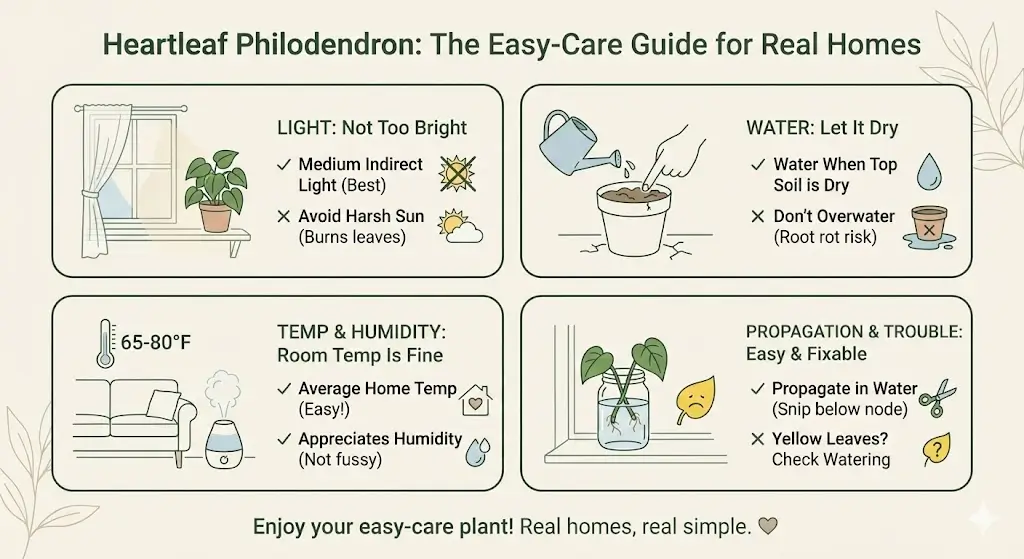
One of the biggest reasons people struggle with houseplants is misunderstanding light. The heartleaf philodendron prefers bright, indirect light, but it also tolerates lower light better than most plants.
Best light conditions
- Bright indirect light near a window
- East or north facing windows are ideal
- Filtered light through sheer curtains works well
What happens in low light
- Slower growth
- Smaller leaves
- Longer gaps between leaves on vines
What happens in too much direct sun
- Leaf scorch
- Faded or yellow patches
- Crispy leaf edges
If you can comfortably read a book during the day without turning on lights, your philodendron can probably live there.
How Often to Water Heartleaf Philodendron
Overwatering is the number one cause of death for this plant. The roots need oxygen as much as they need moisture.
A realistic watering rule
Water only when the top 2 inches of soil feel dry to the touch.
In most homes:
- Spring and summer: every 7 to 10 days
- Fall and winter: every 10 to 14 days
Do not follow a fixed schedule. Temperature, light, pot size, and humidity all affect how fast soil dries.
| What you notice | Likely cause | What to do |
|---|---|---|
| Yellowing leaves, especially lower ones | Overwatering or poor drainage | Let soil dry more between waterings and confirm drainage holes are clear |
| Soft or mushy stem near the soil | Root stress from soggy soil | Stop watering, improve airflow, and consider repotting into fresh, airy mix |
| Limp or curling leaves | Underwatering or very dry air | Water thoroughly, then monitor moisture and adjust frequency |
| Very dry, lightweight soil | Soil has fully dried out | Rehydrate slowly and check again in a day or two |
If unsure, wait one more day. This plant handles dry soil far better than soggy roots.
Soil and Potting That Actually Works
Heartleaf philodendron needs soil that drains well while holding some moisture.
Ideal soil mix
- Regular indoor potting soil
- Added perlite or orchid bark for airflow
- Avoid dense garden soil
A good premixed indoor potting mix works fine if it drains freely.
Pot choice matters
- Always use a pot with drainage holes
- Plastic pots retain moisture longer
- Terracotta pots dry faster and reduce overwatering risk
Repot only when roots circle the pot or grow through drainage holes, usually every 1 to 2 years.
Temperature and Humidity Expectations
This plant prefers normal home conditions.
Temperature range
- Ideal: 65 to 85°F
- Avoid cold drafts and sudden temperature drops
- Do not expose to frost
Humidity
- Average indoor humidity is enough
- Higher humidity encourages larger leaves
- No humidifier required, but it helps
If your home is comfortable for you, it is comfortable for this plant.
How to Grow Fuller, Healthier Vines
Many people complain that their philodendron becomes long and sparse. This is not a defect. It is how the plant grows when left unpruned.
To encourage fullness
- Prune vines regularly above a leaf node
- Rotate the plant so all sides get light
- Provide brighter indirect light
- Fertilize lightly during the growing season
Each cut encourages branching, resulting in a bushier plant.
Fertilizing Without Overdoing It
This plant is not a heavy feeder.
Simple fertilizing approach
- Use a balanced liquid houseplant fertilizer
- Dilute to half strength
- Feed once a month in spring and summer
- Do not fertilize in winter
Overfertilizing causes salt buildup, leaf burn, and weak growth. Less is more.
Easy Propagation Step by Step
Propagation is one of the most rewarding parts of owning a heartleaf philodendron.
What you need
- Clean scissors
- A healthy vine
- Water or moist soil
Steps
- Cut a vine just below a node where a leaf and aerial root grow
- Place the cutting in water or moist soil
- Keep in bright indirect light
- Roots form in 2 to 4 weeks
- Transplant once roots are a few inches long
This is an excellent way to make your plant fuller or share with others.
Common Problems and How to Fix Them
| Problem | Most common cause | Fix |
|---|---|---|
| Yellow leaves | Overwatering or poor drainage | Let soil dry more between waterings, confirm drainage, and consider a chunkier soil mix |
| Small new leaves | Low light or low nutrients | Move to brighter indirect light and fertilize lightly in the growing season |
| Leggy vines | Plant stretching for light and lack of pruning | Prune above nodes and increase light gradually |
| Brown leaf tips | Dry air, inconsistent watering, or fertilizer salts | Water more consistently, flush soil occasionally, and avoid overfertilizing |
Is Heartleaf Philodendron Safe for Pets and Children?
No. Like most philodendrons, it contains calcium oxalate crystals.
Important safety notes
- Toxic if chewed by cats, dogs, or children
- Can cause mouth irritation and drooling
- Rarely fatal, but still dangerous
Keep the plant out of reach of pets and young children.
Why This Plant Is Ideal for Beginners
Heartleaf philodendron succeeds where many plants fail because it:
- Forgives missed watering
- Adapts to different light levels
- Signals problems early
- Grows steadily without complex care
It teaches good plant care habits without punishing mistakes harshly.
Long Term Care and Maintenance Tips
- Dust leaves monthly to improve photosynthesis
- Rotate the pot for even growth
- Refresh soil every few years
- Prune regularly to maintain shape
This plant can live for decades with basic care.
Final Thoughts
If you want a plant that grows with you as you learn, Philodendron hederaceum is one of the best choices available.
It does not demand perfection. It responds well to attention but survives neglect. Most importantly, it rewards patience with lush, trailing growth that improves indoor spaces.
If you care for it thoughtfully and observe how it responds in your specific environment, it will teach you more about plant care than any care chart ever could.