
Pirated streaming sites often look like an easy way to watch movies, TV shows, live sports, or premium content for free. But the real cost can be much higher than users expect. These sites can expose users to malware, phishing, fake apps, payment scams, privacy tracking, suspicious ads, and copyright risk.
This guide explains the main risks of pirated streaming in clear, practical language. It is written for users who want to understand why free unauthorized streaming sites can be dangerous and how to find safer legal ways to watch content online.
Throughout this guide, Flixtor is used as one example of a piracy-associated streaming name, but the risks apply more broadly to unauthorized streaming websites, clone sites, mirror pages, proxy pages, illegal streaming apps, and suspicious APK downloads.
Important note: This article is for educational purposes only. It does not provide pirated streaming links, Flixtor mirror links, proxy links, bypass instructions, APK downloads, or access methods for unauthorized streaming services.
Quick Answer: What Are the Main Risks of Pirated Streaming?
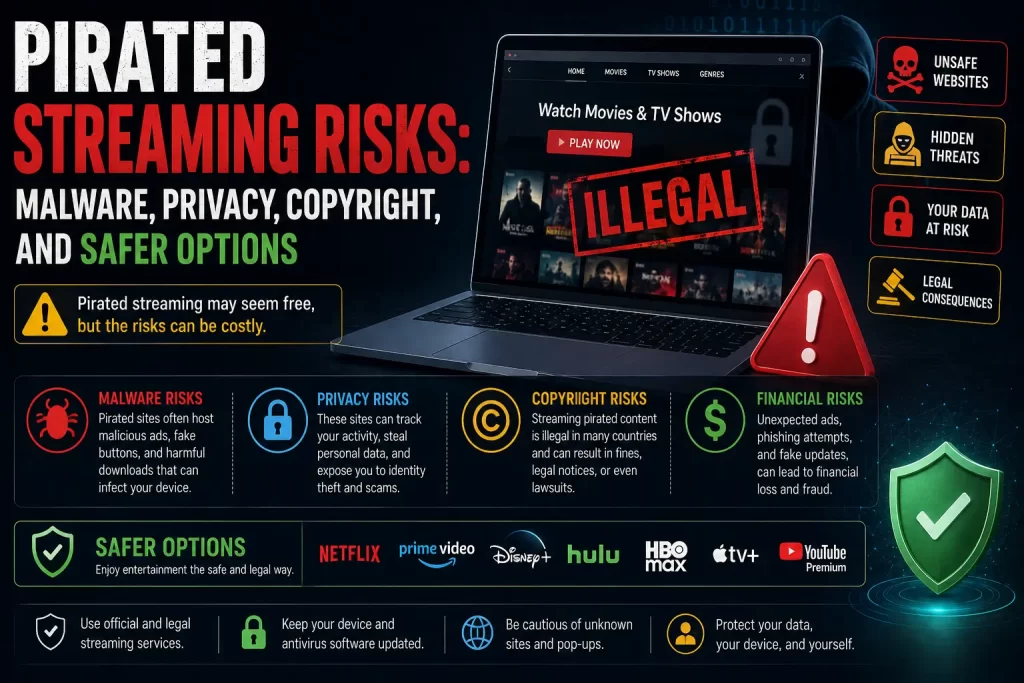
The main risks of pirated streaming include malware, phishing, privacy tracking, fake download buttons, unsafe apps, payment scams, identity-theft risk, browser notification abuse, copyright uncertainty, and exposure to clone sites or mirror pages that may not be connected to the service users expected.
The U.S. Federal Trade Commission warns that websites offering free movies and TV shows can infect computers with malware. It also warns that illegal pirate apps and add-ons can expose users to malware that may steal credit card details, login credentials, banking credentials, photos, and other personal information. You can read the FTC warning here: Malware from illegal video streaming apps.
Copyright risk is also important. The U.S. Copyright Office explains that copyright protects original works of authorship, including movies, as soon as they are fixed in a tangible form of expression. You can read its explanation here: What Is Copyright?
The safest recommendation is to avoid pirated streaming sites and use licensed streaming platforms, official apps, rental services, free legal ad-supported platforms, or legal discovery tools such as JustWatch.
Related guide: What Is Flixtor? Safety, Legality, Risks, and Legal Alternatives Explained
What Is Pirated Streaming?
Pirated streaming usually means watching copyrighted movies, TV shows, live sports, or other protected content through a website, app, add-on, or device that does not clearly have permission from the copyright owner or authorized distributor.
Pirated streaming can appear in different forms, including:
- Free movie streaming websites
- Unauthorized TV show streaming websites
- Live sports piracy streams
- Mirror and proxy pages for blocked sites
- Clone sites using popular streaming names
- Unofficial apps and APK downloads
- Streaming-device add-ons
- Fake “premium” or VIP streaming subscriptions
- Social media pages sharing unauthorized streams
- Embedded players hosted through unclear third parties
Not every free streaming platform is illegal. Some legal services are free because they are ad-supported or publicly funded. The important difference is whether the platform is licensed, transparent, and available through official channels.
Why Do People Use Pirated Streaming Sites?
People often use pirated streaming sites because legal streaming can feel fragmented, expensive, or confusing. A movie may be on one platform in one country and another platform in another country. A user may already pay for multiple subscriptions and still not find the title they want.
Common reasons people search for pirated streaming include:
- They want free access to movies or TV shows.
- They cannot find a title on their current subscriptions.
- A show is not available in their country.
- They do not want another subscription.
- They want to watch a live event without paying.
- They are following links shared on forums or social media.
- They do not understand the risks of unauthorized streaming.
- They think streaming is safer than downloading.
These frustrations are real, but they do not remove the risks. A free unauthorized stream can still expose users to malware, phishing, unsafe ads, privacy tracking, and legal uncertainty.
Malware Risks
Malware is one of the biggest risks of pirated streaming. A site may look like a normal video page, but the surrounding ads, redirects, fake buttons, or downloads may expose users to harmful software.
Malware exposure can happen through:
- Fake play buttons
- Fake download buttons
- Fake browser updates
- Fake video-player updates
- Fake codec downloads
- Malicious pop-ups
- Browser extension prompts
- Unofficial APK files
- Streaming-device add-ons
- Redirect chains
- Fake antivirus warnings
- Notification-permission abuse
Some users assume they are safe if they only stream and never intentionally download anything. That is not always true. Unsafe streaming pages can push accidental downloads, permission prompts, browser hijackers, or fake verification steps.
Related guide: Is Flixtor Safe? Malware, Fake Sites, Ads, and Privacy Risks Explained
Phishing and Account-Theft Risks
Pirated streaming sites can also expose users to phishing. Phishing happens when criminals try to trick users into opening harmful links, entering personal information, or installing harmful files. CISA explains that phishing can involve harmful links, emails, or attachments that request personal information or infect devices. You can review CISA’s guidance here: Recognize and Report Phishing.
Phishing on streaming sites may appear as:
- Fake login pages
- Fake account-verification pages
- Fake “prove you are human” forms
- Fake VIP login pages
- Fake refund pages
- Fake password reset forms
- Fake app download pages
- Fake customer support chats
- Emails claiming a streaming account is expiring
Password reuse makes phishing more dangerous. If a user enters the same password used for email, banking, social media, or work accounts, one fake streaming login can lead to wider account compromise.
Privacy and Tracking Risks
Pirated streaming sites often have unclear privacy practices. Users may not know who operates the site, what data is collected, which third parties receive it, or how long it is stored.
Potential privacy risks include:
- IP address collection
- Browser fingerprinting
- Third-party advertising trackers
- Cookies and cross-site tracking
- Email harvesting
- Device identifier collection
- Account activity tracking
- Payment-data exposure
- Unclear data deletion options
- Tracking through redirects and pop-ups
Legal streaming platforms can also collect user data, but they typically provide visible privacy policies, account controls, app-store disclosures, and support channels. Pirated streaming sites may not provide the same transparency or accountability.
Payment and Fake Subscription Risks
Some pirated streaming sites ask users to pay for VIP access, premium accounts, ad-free viewing, faster servers, or account verification. Users should be very careful with these pages.
Payment risks include:
- Card details entered into an unknown website
- Fake “free verification” forms
- Recurring charges that are difficult to cancel
- No refund process
- Unclear billing names
- Fake support pages
- Cryptocurrency payments that cannot be reversed
- Payment forms connected to clone sites
- Account details stolen during signup
Paying a streaming site does not prove that the site has legal rights to stream the content. It only increases the amount of sensitive information at risk.
Related guide: Flixtor VIP: Payment, Account, and Privacy Risks Users Should Know
Fake Apps, APKs, and Streaming Device Add-Ons
Pirated streaming is not limited to websites. It can also appear through apps, APK files, streaming-device add-ons, and unofficial device packages.
Fake app and APK risks include:
- Malware hidden inside app files
- Adware that shows aggressive ads
- Spyware that collects device data
- Apps that ask for unnecessary permissions
- Apps that redirect to unsafe websites
- Apps that collect login credentials
- Apps that push fake subscriptions
- Apps that are difficult to remove
- Apps that bypass normal app-store review
The FTC specifically warns that pirate apps and add-ons can affect streaming devices and may infect other devices on the same wireless network.
Users should install only official apps from verified app stores or official platform websites.
Related guide: Is There a Flixtor App? What to Know Before Downloading Anything
Clone Sites, Mirrors, and Proxy Pages
Clone sites, mirrors, and proxy pages are common in the pirated streaming ecosystem. When one site stops working or gets blocked, users may search for a replacement. Copycat pages can take advantage of that search behavior.
These pages may claim to be:
- The official version
- The new domain
- A working mirror
- A proxy page
- A safe replacement
- A VIP login page
- A mobile app download page
Flixtor is a useful example. In 2018, TorrentFreak reported that Flixtor experienced downtime and that Flixtor’s operators warned users about impostor sites appearing during that period. You can read the report here: Flixtor Promises to Return More Resilient and Better Than Ever.
Users should avoid searching for mirrors, proxies, or replacement domains. Those searches can lead to fake pages, phishing, malware, payment scams, and copyright uncertainty.
Related guide: Flixtor Clone Sites: How to Spot Fake Streaming Websites
Copyright and Legal Risks
Pirated streaming can create copyright risk because movies, TV shows, live sports, music, and other creative works are usually protected by copyright.
The exact legal risk depends on the user’s country, the type of content, how the service works, and what the user does. Some countries focus enforcement on operators and distributors. Others use site blocking, notices, payment-provider action, or other measures. Users may face greater risk if they download, redistribute, upload, share links, pay for unauthorized access, or use unauthorized streams in public or commercial settings.
USTR’s 2025 Review of Notorious Markets describes online and physical markets that reportedly engage in or facilitate substantial counterfeiting or copyright piracy, including piracy-enabling services such as streaming sites. You can read USTR’s release here: USTR 2025 Review of Notorious Markets.
This article is not legal advice. The safest general recommendation is to use licensed streaming platforms, rental services, and official apps.
Related guide: Is Flixtor Legal? Copyright Issues and Streaming Risks Explained
Ads, Pop-Ups, Redirects, and Fake Buttons
Many pirated streaming sites rely on aggressive advertising and redirect chains. Even if the user never downloads a file, interacting with ads and fake buttons can create risk.
Unsafe ad behavior can include:
- Multiple pop-ups after one click
- Redirects to unrelated websites
- Fake play buttons
- Fake download buttons
- Fake CAPTCHA screens
- Fake virus warnings
- Fake browser update prompts
- Fake “allow notifications” prompts
- Adult, gambling, or scam redirects
- Payment pages for “free verification”
Legal streaming platforms may show ads if they are ad-supported, but those ads are usually served inside a controlled platform environment. Pirated streaming sites often do not provide the same safety controls.
Device and Network Risks
Pirated streaming can affect more than the browser tab being used. Unsafe apps, extensions, and add-ons may affect the device or other devices on the same network.
Possible device and network risks include:
- Device slowdown
- Unwanted browser extensions
- Notification spam
- Browser hijacking
- Suspicious background activity
- Malicious streaming-device add-ons
- Risk to other devices on the same network
- Unauthorized access to files or media
- Apps that are difficult to remove
- Security warnings from browsers or antivirus tools
Users should keep browsers, operating systems, and security tools updated. They should also avoid installing software, extensions, or apps from unknown streaming pages.
Family and Child Safety Risks
Pirated streaming sites can be especially risky for families because they may show uncontrolled ads, pop-ups, adult content, gambling promotions, scam pages, or misleading download buttons.
Family-related risks include:
- Exposure to inappropriate ads
- Accidental clicks on fake buttons
- Downloads of unwanted apps or extensions
- Notification spam
- Phishing pages disguised as verification screens
- Payment pages reached by accident
- No parental controls
- No content ratings or account profiles
Legal streaming services often provide parental controls, profiles, maturity ratings, kid-friendly sections, and account settings. These controls are one reason legal platforms are safer for shared family devices.
Risks for Businesses, Schools, and Public Spaces
Pirated streaming can be especially risky in workplaces, schools, hotels, restaurants, gyms, offices, and public spaces.
Risks can include:
- Copyright exposure from public or commercial viewing
- Malware risk on shared devices
- Network security issues
- Inappropriate ads appearing in public spaces
- Credential theft on shared computers
- IT policy violations
- Reputational risk
Organizations should use licensed content sources, official business accounts, or properly licensed public-performance options when required. Free unauthorized streams should not be used in commercial or public environments.
Warning Signs of an Unsafe Streaming Site
Users should be cautious if a streaming site shows any of these warning signs:
- It claims to offer every new movie or show for free.
- It has no clear company information.
- It has no licensing explanation.
- It uses mirrors, proxies, or frequently changing domains.
- It shows multiple fake play buttons.
- It opens many pop-ups or redirects.
- It asks for notification permissions.
- It asks users to install a browser extension.
- It asks users to download an APK or video player.
- It requests card details for “free verification.”
- It has fake-looking reviews or unclear support.
- It uses lookalike names of known platforms.
- It asks users to disable security settings.
- It makes promises that sound too good to be true.
One red flag may be enough to avoid the site. Several red flags together are a strong sign that the site is unsafe.
What to Do If You Used a Pirated Streaming Site
If you already used a pirated streaming site, take practical safety steps.
- Close suspicious pages. Stop clicking through pop-ups, redirects, fake players, and verification screens.
- Clear notification permissions. Remove unknown sites from browser notification settings.
- Remove unknown browser extensions. Check your browser for unfamiliar add-ons.
- Uninstall suspicious apps or APKs. Remove anything installed after using the site.
- Run a malware scan. Use a trusted security tool.
- Update your device. Install browser and operating-system updates.
- Change reused passwords. Start with email, banking, social, and work accounts.
- Enable two-factor authentication. Add protection to important accounts.
- Monitor payments. If you entered card details, check statements and contact your bank if needed.
- Watch for phishing. Be careful with emails or texts related to streaming accounts, refunds, or renewals.
If you think you entered information on a scam page, act quickly. Changing passwords, enabling two-factor authentication, and contacting your bank can reduce further damage.
Safer Legal Streaming Alternatives
The safest alternative to pirated streaming is a legal platform or legal discovery tool.
Safer options include:
- Paid streaming platforms such as Netflix, Prime Video, Disney+, Apple TV, Hulu, Max, Paramount+, Peacock, and regional services
- Free legal ad-supported platforms such as Tubi, Pluto TV, Plex, and broadcaster-owned services where available
- Digital rental and purchase platforms such as YouTube Movies, Google TV, Apple TV, and Prime Video rentals
- Official broadcaster apps and TV-network apps
- Library-linked streaming services where available
- Legal discovery tools such as JustWatch
JustWatch helps users find where movies, TV shows, and sports are legally available across streaming services. You can visit the platform here: JustWatch.
A good money-saving strategy is to combine free legal ad-supported platforms with occasional rentals and one or two rotating paid subscriptions.
Related guide: Best Legal Flixtor Alternatives for Movies and TV Shows
Pirated Streaming vs Legal Streaming Platforms
This table summarizes the key differences between pirated streaming and legal streaming.
| Factor | Pirated Streaming Sites | Legal Streaming Platforms |
|---|---|---|
| Content rights | Unclear or unauthorized | Licensed content agreements |
| Malware risk | Higher due to pop-ups, downloads, ads, and fake apps | Lower when using official apps and websites |
| Privacy transparency | Often unclear | Published privacy policies and account settings |
| Payment safety | Risky VIP pages and fake verification forms | Standard billing, receipts, and support |
| App safety | May involve APKs, fake apps, and unsafe add-ons | Official app-store listings |
| Reliability | Unstable, blocked, cloned, or redirected | More stable and supported |
| Family controls | Usually absent | Profiles, ratings, and parental controls are often available |
| Legal certainty | May carry copyright risk | Designed for legal viewing |
Final Verdict
Pirated streaming is not a safe shortcut. It can expose users to malware, phishing, privacy tracking, payment scams, fake apps, clone sites, suspicious ads, and copyright uncertainty.
The safest approach is to avoid unauthorized streaming websites, mirror pages, proxy lists, APK downloads, fake VIP pages, and unknown browser extensions. Use licensed streaming platforms, official broadcaster apps, free legal ad-supported services, rental platforms, or legal discovery tools instead.
A stream that plays is not proof that a site is safe, legal, licensed, or trustworthy. If a platform cannot clearly show who operates it, how it licenses content, and how it protects users, it is not worth the risk.
FAQs About Pirated Streaming Risks
What are pirated streaming risks?
Pirated streaming risks include malware, phishing, payment scams, privacy tracking, unsafe apps, fake downloads, browser notification abuse, clone sites, and copyright uncertainty.
Can pirated streaming give you malware?
Yes. Pirated streaming sites can expose users to malware through fake play buttons, pop-ups, redirects, browser extensions, APK downloads, and illegal streaming apps or add-ons.
Is streaming safer than downloading?
Not necessarily. Even if users do not intentionally download files, unsafe streaming pages can push accidental downloads, fake updates, malicious ads, phishing forms, and notification abuse.
Can pirated streaming sites steal passwords?
Yes. Fake login pages and phishing forms can collect email addresses and passwords. Password reuse can put email, banking, social, and work accounts at risk.
Can pirated streaming sites steal payment details?
Yes. Fake VIP pages, fake account verification forms, and suspicious payment pages can expose users to card theft, recurring charges, or scams.
Are pirated streaming apps safe?
No. Unofficial streaming apps, APKs, and device add-ons can expose users to malware, privacy tracking, unwanted ads, and account theft.
Are mirror and proxy sites safe?
No. Mirror and proxy sites may be clone pages, phishing pages, malware sources, or unauthorized streaming pages. They should be avoided.
Is pirated streaming illegal?
Copyright laws vary by country, but watching copyrighted content through unauthorized services can create legal uncertainty. Downloading, uploading, sharing, or paying for unauthorized access can increase risk.
What should I do if I used a pirated streaming site?
Clear suspicious browser permissions, remove unknown extensions or apps, run a malware scan, update your device, change reused passwords, enable two-factor authentication, and monitor payment accounts if you entered card details.
What should I use instead of pirated streaming sites?
Use licensed streaming platforms, free legal ad-supported services, official broadcaster apps, rental platforms, library-linked services, or legal discovery tools such as JustWatch.
Sources and Further Reading
- Federal Trade Commission: Malware from Illegal Video Streaming Apps
- CISA: Recognize and Report Phishing
- U.S. Copyright Office: What Is Copyright?
- USTR: 2025 Review of Notorious Markets for Counterfeiting and Piracy
- TorrentFreak: Flixtor Promises to Return More Resilient and Better Than Ever
- JustWatch: Streaming Availability Search
Disclaimer
This article is for general educational and informational purposes only. It does not provide legal advice, cybersecurity advice, financial advice, or instructions for accessing unauthorized streaming services. Copyright laws, streaming availability, enforcement practices, and app listings vary by country and can change over time. Users should rely on licensed streaming platforms, official app stores, payment providers, banks, cybersecurity professionals, and legal sources whenever possible.