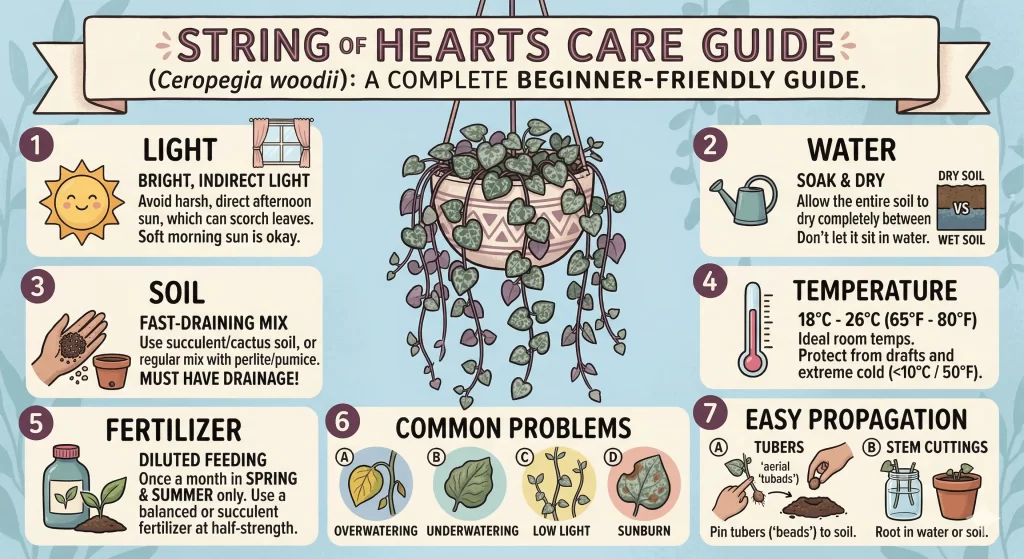

String of Hearts Care Guide (Ceropegia woodii): A Complete Beginner-Friendly Guide
Quick Summary
| Plant name | String of Hearts (Ceropegia woodii) |
|---|---|
| Best for | Beginners and indoor plant lovers |
| Light | Bright, indirect sunlight |
| Water | Only when soil is dry |
| Growth | Fast-growing trailing vine |
| Propagation | Easy through cuttings or tubers |
| Common issue | Overwatering |
If you want a low-maintenance, beautiful trailing plant that is hard to kill and easy to multiply, String of Hearts is one of the best choices for your indoor space.
What Is String of Hearts and Why Is Everyone Talking About It
String of Hearts, also known as Ceropegia woodii, is a delicate trailing succulent known for its heart-shaped leaves and long cascading vines. It is one of the most loved houseplants for people who want something beautiful without needing constant attention.
Here is why so many plant lovers choose it:
- It looks attractive in almost any room
- It grows long, elegant vines
- It does not need daily care
- It is beginner-friendly
- It is easy to propagate into new plants
If you have struggled with houseplants before, this one is a very good place to start.
Who This Guide Is For
This guide is written for beginners, busy plant owners, and anyone who wants a clear and practical care guide for String of Hearts.
By the end of this article, you will know:
- How much light it needs
- How often to water it
- What type of soil works best
- How to fix common care problems
- How to propagate it successfully
String of Hearts Care Guide
Light Requirements
String of Hearts grows best in bright, indirect light. A spot near a window with filtered sunlight usually works well. Gentle morning sun can help growth, but strong afternoon sun may stress the plant if it is too intense.
Good light conditions include:
- Near an east-facing window
- Close to a bright window with a sheer curtain
- In a room that gets plenty of natural light
If the leaves become pale or the spaces between leaves get longer, your plant may need more light.
Watering
Watering is the most important part of caring for String of Hearts. Since it is a semi-succulent plant, it stores some moisture and prefers to dry out between waterings.
The best rule is simple: only water when the soil feels fully dry.
A practical watering routine looks like this:
- Check the soil with your finger
- If the top few inches feel dry, water thoroughly
- Let excess water drain out completely
- Do not water again until the soil is dry
| Condition | What It Usually Means |
|---|---|
| Yellow leaves | Too much water |
| Leaves falling off | Often overwatering or stress |
| Wrinkled leaves | Plant may need water |
| Soft stems | Possible root rot from excess moisture |
In most homes, watering every 10 to 14 days works well, but this can vary depending on heat, light, pot size, and season.
Soil and Pot Setup
String of Hearts needs soil that drains well. Heavy soil that stays wet for too long can lead to root rot.
A good potting setup should include:
- A well-draining cactus or succulent mix
- Extra perlite or coarse sand for better airflow
- A pot with drainage holes
Terracotta pots are a great option because they help excess moisture evaporate faster than plastic pots.
Temperature and Humidity
This plant grows well in normal indoor temperatures. It does not need high humidity, which makes it ideal for most homes and apartments.
Keep it away from:
- Very cold drafts
- Frost or freezing conditions
- Sudden temperature drops
If your room feels comfortable to you, it will usually feel comfortable to your String of Hearts as well.
Common Problems and How to Fix Them
1. Leaves Falling Off
If your plant is dropping leaves, the most common causes are overwatering, poor light, or sudden environmental stress.
To fix it:
- Let the soil dry out fully before watering again
- Move the plant to a brighter spot
- Avoid moving it too often
2. Yellow Leaves
Yellow leaves are usually a sign that the plant is staying too wet for too long. This often happens when the soil holds too much moisture or the pot does not drain well.
To fix it:
- Reduce watering frequency
- Check that the pot has drainage holes
- Use a lighter, better-draining soil mix
3. Slow Growth
If your String of Hearts is barely growing, it may not be getting enough light. Growth can also slow if the soil is old and compacted.
To improve growth:
- Place it closer to a bright window
- Refresh the soil if needed
- Feed lightly during the growing season if appropriate
4. Leggy Vines
Long, thin vines with fewer leaves usually mean the plant is stretching for more light.
To fix it:
- Increase light exposure
- Trim overly stretched vines
- Propagate healthy sections to make the plant look fuller
How to Propagate String of Hearts
One of the best things about String of Hearts is how easy it is to propagate. You can create new plants from cuttings, nodes, or tubers with very little effort.
Method 1: Water Propagation
- Cut a healthy vine below a node
- Place the node in water
- Keep it in bright, indirect light
- Wait for roots to grow
- Transfer it to soil once roots are established
Method 2: Soil Propagation
- Lay a vine across the surface of moist soil
- Press the nodes gently into the soil
- Keep the soil lightly moist at first
- Wait for roots to form at the nodes
Method 3: Tuber Propagation
String of Hearts often produces small bead-like tubers along the vines. These can be placed on top of soil or lightly covered to grow into new plants.
- Identify healthy tubers
- Place them on well-draining soil
- Water lightly
- Keep them in bright light until growth begins
How Fast Does String of Hearts Grow
Under the right conditions, String of Hearts can grow quite quickly during spring and summer. Its vines can become several feet long over time, especially when it gets plenty of bright light.
Growth is usually strongest when the plant has:
- Bright, indirect sunlight
- Correct watering habits
- Well-draining soil
- Warm indoor temperatures
Growth often slows down during winter, which is normal.
Best Ways to Display String of Hearts
This plant is not only easy to care for, but also highly decorative. Its trailing vines make it a strong choice for styling indoor spaces.
Popular display ideas include:
- Hanging baskets
- Wall-mounted shelves
- Plant stands near windows
- Bedroom or living room corners with bright light
If you want a plant that adds softness and movement to a room, this is a great option.
Frequently Asked Questions
How often should I water String of Hearts?
In many homes, watering every 10 to 14 days is enough. Always check the soil first rather than watering on a strict schedule.
Can String of Hearts grow in low light?
It can survive in lower light, but it usually will not thrive. Growth may become weak, slow, and leggy.
Is String of Hearts good for beginners?
Yes. It is one of the best beginner-friendly trailing houseplants because it is low-maintenance and forgiving when cared for properly.
Why are the leaves on my String of Hearts shrinking?
Shrinking or wrinkled leaves usually mean the plant needs water. Check the soil and adjust your watering routine if needed.
Why is my String of Hearts not growing?
The most common reason is insufficient light. Review its placement and make sure it is getting bright, indirect sunlight.
Final Thoughts
If you remember only a few basics, you will already be on the right track with String of Hearts.
- Give it bright light
- Let the soil dry before watering
- Use a pot and soil setup that drains well
Most problems happen because owners try to do too much. With this plant, a simple routine usually works best.
If you want a trailing houseplant that looks elegant, grows beautifully, and does not demand constant attention, String of Hearts is an excellent choice for beginners and experienced plant lovers alike.