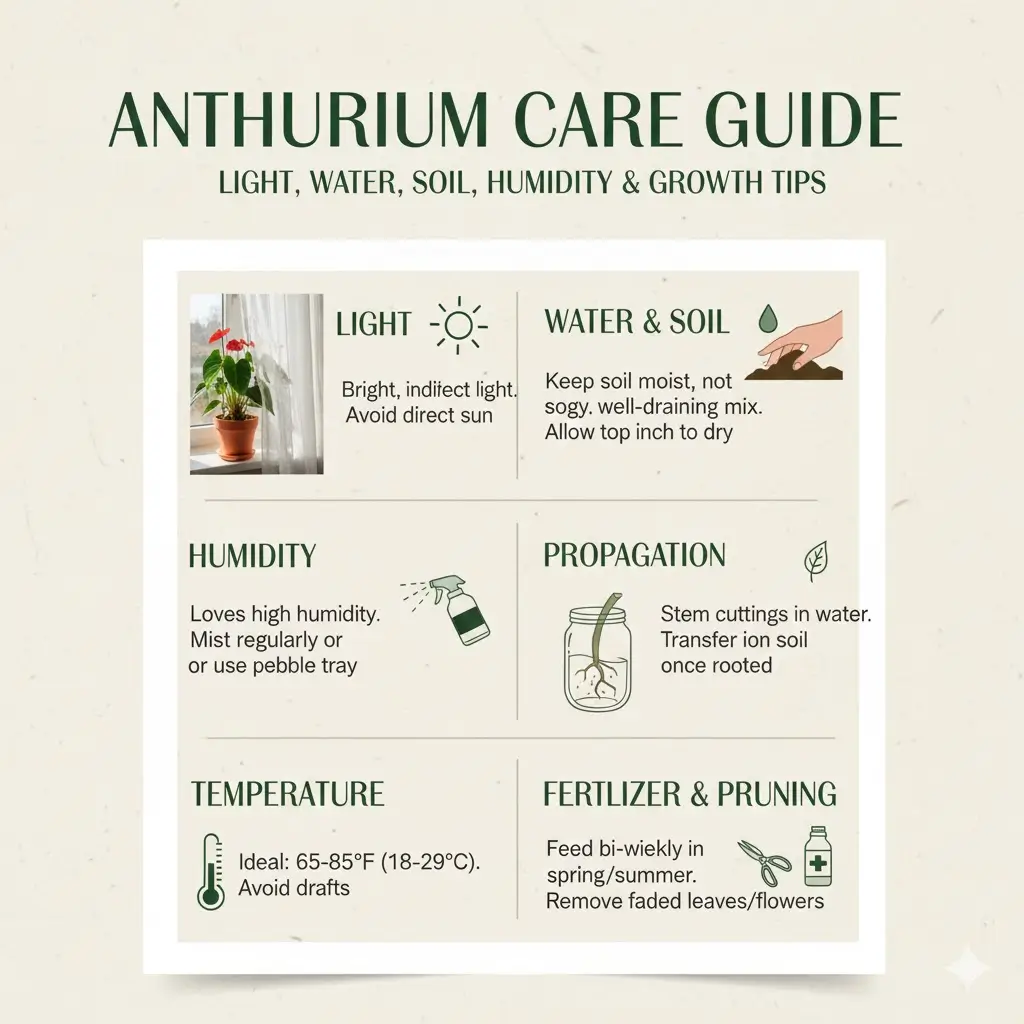

Anthurium Care Guide: Light, Water, Soil, Humidity, Propagation and Growth Tips
TL;DR
Anthuriums prefer bright indirect light, consistently moist but well draining soil and high humidity. Maintain temperatures between 18 and 27°C and avoid exposing the roots to standing water. Fertilize lightly during the growing season and repot every 1 to 2 years. These plants thrive in warm, humid environments and reward consistent care with glossy leaves and long lasting flowering spathes.
Introduction
Anthurium spp., commonly known as Flamingo Flower or Laceleaf, are tropical plants prized for their glossy foliage and colorful heart shaped spathes. Native to the rainforests of Central and South America, they grow as epiphytes or terrestrials in warm, humid environments with filtered light. Their long lasting blooms and elegant structure make them popular indoor ornamental plants.
With the right balance of humidity, indirect light and controlled watering, Anthuriums can flourish indoors and produce flowers several times a year.
Plant Overview
| Botanical Name | Anthurium spp. |
| Common Names | Flamingo Flower, Laceleaf, Tailflower |
| Plant Type | Tropical evergreen (epiphytic or terrestrial) |
| Difficulty Level | Moderate |
| Growth Rate | Moderate |
| Toxicity | Toxic to pets and humans if ingested |
| Light | Bright indirect light |
| Water | Keep soil lightly moist, never waterlogged |
| Soil | Chunky, well draining aroid mix |
| Temperature | 18 to 27°C |
| Humidity | 60 to 80 percent preferred |
| Bloom Time | Intermittent year round indoors |
What Anthuriums Look Like
Anthuriums have broad, glossy leaves that range from heart shaped to elongated depending on the species. Their signature feature is the brightly colored spathe, a modified leaf that surrounds a central spadix. Colors range from red, pink and white to green and purple. Anthuriums grow upright, producing new leaves and flowers from the plant’s center, and can reach 30 to 60 cm indoors.
In nature, they grow on forest floors or attached to trees, receiving gentle light, consistent moisture and high humidity.
Complete Care Guide
1. Light Requirements
Anthuriums prefer bright, indirect light. Too much direct sun can burn the leaves, while too little light reduces flowering.
- Best location: near an east or north facing window
- Use sheer curtains for south or west windows
- Fluorescent or LED grow lights are suitable in low light homes
Low light signs: slow growth, small leaves, reduced flowering.
Excessive light signs: yellowing, crispy leaf edges or brown patches.
2. Watering Instructions
Anthuriums prefer evenly moist soil but do not tolerate standing water. The key is moisture without saturation.
- Water when the top 2 to 3 cm of soil feels lightly dry
- Always allow excess water to drain completely
- Use room temperature water
Seasonal watering:
- Spring and summer: water more frequently with active growth
- Autumn and winter: reduce slightly as growth slows
Overwatering signs: yellow leaves, root rot, wilting despite wet soil.
Underwatering signs: dry leaf tips, curling leaves, slow growth.
3. Soil Requirements
Anthuriums need a loose, chunky mix similar to what epiphytic plants receive in the wild. This allows water to drain rapidly while retaining some moisture.
- Aroid mix (orchid bark, perlite, peat or coco coir)
- Orchid bark + perlite + potting soil
- Coconut husk chips + perlite
Avoid dense soil which traps water and leads to root rot.
4. Temperature and Humidity
Temperature
- Ideal range: 18 to 27°C
- Below 15°C may stunt growth
- Protect from drafts and sudden temperature changes
Humidity
- Prefers 60 to 80 percent humidity
- Use a humidifier for dry climates
- Place on a pebble tray to raise local humidity
- Mist lightly, avoiding flowers
5. Fertilizer Guidance
Anthuriums benefit from light, consistent feeding during the growing season.
- Use a balanced, diluted fertilizer every 4 weeks
- Switch to a phosphorus rich fertilizer to support flowering
- Do not fertilize during winter dormancy
6. Pruning and General Maintenance
Routine maintenance helps Anthuriums stay healthy and encourages fresh growth.
- Remove yellow or damaged leaves
- Cut spent flowers to encourage new blooms
- Wipe leaves with a damp cloth to remove dust
- Rotate the plant for even growth
7. Repotting Instructions
Repot Anthuriums every 1 to 2 years or when roots begin circling the pot.
Repotting steps:
- Remove the plant gently and shake off old soil.
- Trim browned or mushy roots.
- Place in a slightly larger pot with fresh aroid mix.
- Water lightly and keep in bright indirect light.
8. Propagation Methods
Division (most common and reliable):
- Remove plant from pot and separate root clumps.
- Ensure each division has roots and at least one growth point.
- Plant divisions in fresh aroid mix.
Stem Cuttings:
- Cut a stem section with a visible node.
- Allow the cut end to callous for a few hours.
- Plant in moist aroid mix or root in water, then transfer to soil.
9. Common Problems and Solutions
Yellow Leaves
Causes: overwatering, low humidity or nutrient imbalance.
Solution: adjust watering and humidity, check roots.
Brown Leaf Tips
Cause: low humidity or underwatering.
Solution: increase humidity and water consistently.
No Flowers
Cause: insufficient light or nutrients.
Solution: increase indirect light and use bloom support fertilizer.
Pests
Common pests include mealybugs, scale, spider mites and aphids.
- Use neem oil or insecticidal soap
- Improve airflow to reduce infestation risk
Toxicity Information
Anthuriums are toxic if ingested due to calcium oxalate crystals. Keep away from pets and children.
Do’s and Don’ts
| Do | Do Not |
|---|---|
| Provide bright, indirect light | Expose the plant to direct, harsh sunlight |
| Use a loose, chunky aroid soil mix | Use dense, compact potting soil |
| Keep soil consistently moist but never soggy | Allow the plant to sit in standing water |
| Maintain high humidity levels | Place near heaters or cold drafts |
| Repot every 1–2 years | Overfertilize or use full-strength feed |
Seasonal Care Tips
Spring
- Increase humidity and watering
- Resume regular fertilizing
- Repot if needed
Summer
- Maintain strong humidity
- Protect from harsh sun
- Water frequently but avoid overwatering
Autumn
- Reduce feeding slightly
- Maintain steady moisture
Winter
- Lower watering frequency
- Keep away from drafts and cold windows
Styling and Placement Suggestions
Anthuriums add a vibrant, modern look to living rooms, bedrooms and bright bathrooms. Their glossy leaves and bold spathes work well in minimalist ceramic pots, decorative planters or grouped with other tropicals for a lush indoor display.
Growth Expectations
- Height: 30 to 60 cm
- Spread: 25 to 50 cm
- Flower longevity: up to 8 weeks per bloom
- Lifespan: many years with consistent care
Frequently Asked Questions
Why is my Anthurium not flowering?
Usually due to low light. Increase bright, indirect light and provide balanced fertilizer.
Can Anthuriums grow in low light?
They survive, but they will grow slower and may not flower.
How often should I water an Anthurium?
Water when the top few centimeters of soil feel lightly dry. Do not let soil become soggy.
Do Anthuriums need humidity?
Yes. They prefer 60 to 80 percent humidity for optimal leaf and flower health.
Are Anthuriums pet safe?
No. Anthuriums are toxic to pets if ingested.